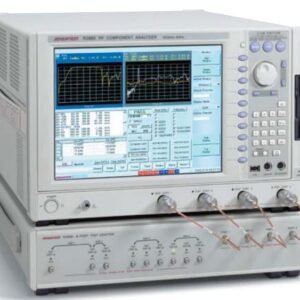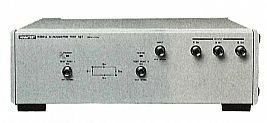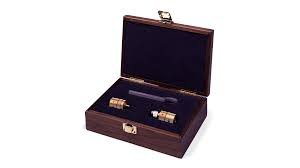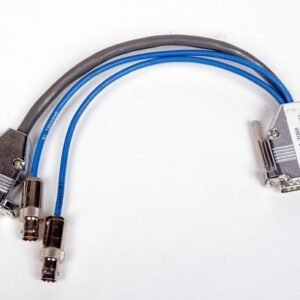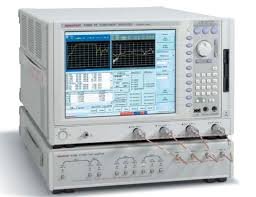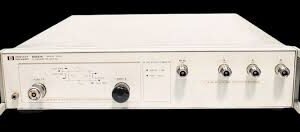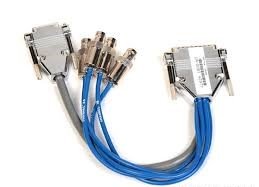
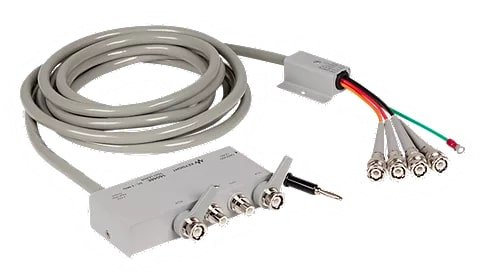

The Keysight 16048E Test Leads extend the measurement capabilities of 4-terminal pair LCR meters and impedance analyzers by providing four BNC male-terminated coaxial leads for connection to user-fabricated test fixtures. This configuration enables accurate component characterization across various bias conditions while maintaining 4-terminal pair measurement integrity.
Technical Specifications
• Configuration: 4-terminal pair fixture with four BNC male coaxial test leads
• Connector Type: BNC male
• Cable Length: 4 meters
• Maximum Voltage: ±42 V peak (AC+DC)
• Frequency Range: DC to 30 MHz
• Weight: 690 g (1.52 lbs)
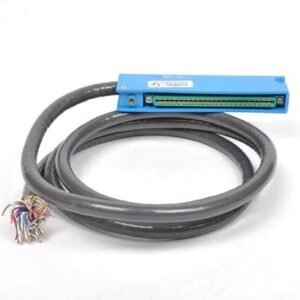
• Included Accessory: BNC female connector board for user-fabricated test fixture attachment
– Key Features
The 16048E delivers direct connection to instrument UNKNOWN and GUARD terminals, enabling straightforward integration into existing measurement setups. Four independent BNC male leads accommodate custom fixture designs without modification. The included BNC female connector board simplifies interface design for user-fabricated fixtures. Green lead connection to chassis or grounded fixture components reduces stray capacitance effects between the Device Under Test and test fixture.
Inherent stray capacitance, residual inductance, and residual resistance require Open/Short compensation—performed per instrument operating manual—to minimize measurement error and achieve rated accuracy.
– Typical Applications
Component characterization under bias conditions. Custom fixture integration for non-standard test geometries. Multi-point impedance measurement across the DC to 30 MHz range. Device screening requiring 4-terminal pair measurement topology.
– Compatibility & Integration
Designed for 4-terminal pair LCR meters and impedance analyzers. Connect directly to instrument UNKNOWN terminals and GUARD terminal, then attach user-fabricated test fixture to the test leads. Grounding: instrument chassis must be connected to safety earth ground via the supplied power cable with earth blade to avoid electric shock hazard.