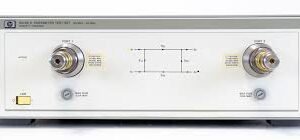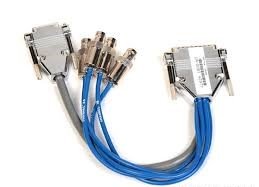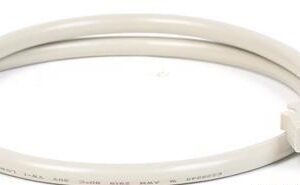
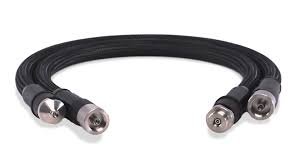

The Agilent/Keysight 85133H is a flexible test port cable engineered for high-frequency network analyzer measurements from DC to 50 GHz. This 63 cm cable connects directly to Keysight network analyzers equipped with male NMD-2.4 mm test ports, delivering the electrical performance and mechanical stability required in demanding RF and microwave test environments.
Technical Specifications
• Frequency Range: DC to 50 GHz
• Length: 63 cm (25 in)
• Connector Configuration: 2.4 mm Female to 2.4 mm Male
• Return Loss: ≥15 dB
• Insertion Loss (Test Port Connector): <0.450 + 0.013F + 0.300√F dB (F in GHz)
• Insertion Loss (Device Connector): 3.22 dB maximum at 50 GHz
• Phase Stability (90° bend, 2.5-inch radius): <0.08 dB and 0.08° × f + 0.5° (f in GHz)
• Minimum Bend Radius: 4 inches (10 cm)
– Key Features
• Flexible cable construction supports field routing and integration into compact test setups without performance degradation over multiple flex cycles when bend radius limits are observed.
• NMD connector design features enlarged coupling threads for enhanced mechanical stability and improved repeatability in repeated connect/disconnect cycles.
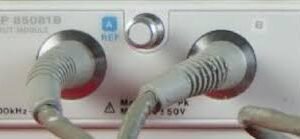
• Female slotted NMD test port connector mates exclusively with male NMD test ports on compatible analyzers; standard connectors are not compatible.
• Low insertion loss across the measurement bandwidth ensures accurate S-parameter and power measurement data with minimal signal attenuation.
• Phase stability specification under mechanical stress (90° bend conditions) supports reliable measurements in applications requiring cable flexing or repositioning.
– Typical Applications
• Network analyzer s-parameter measurements at microwave frequencies
• Fixture and device characterization from 1 GHz through 50 GHz
• Laboratory and production test environments requiring flexible test leads
– Compatibility & Integration
Designed exclusively for Keysight network analyzers with male NMD-2.4 mm test ports. The 85133H is the single female-to-male variant in the 85133F cable set. Handle the fragile center conductor with care; avoid tight coiling, excessive stretching, and repeated tight bends to maintain long-term cable integrity.