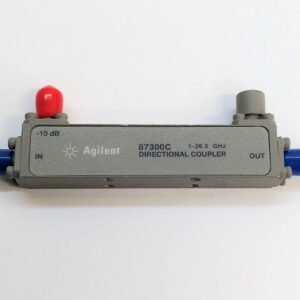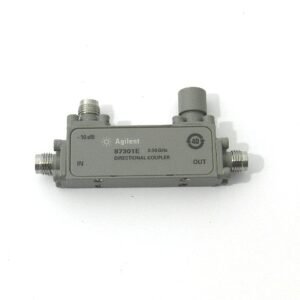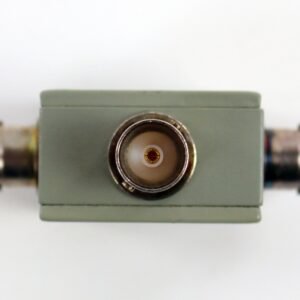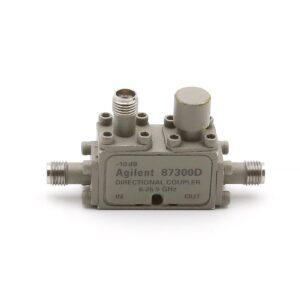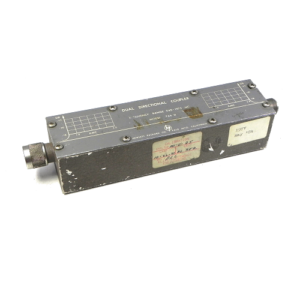
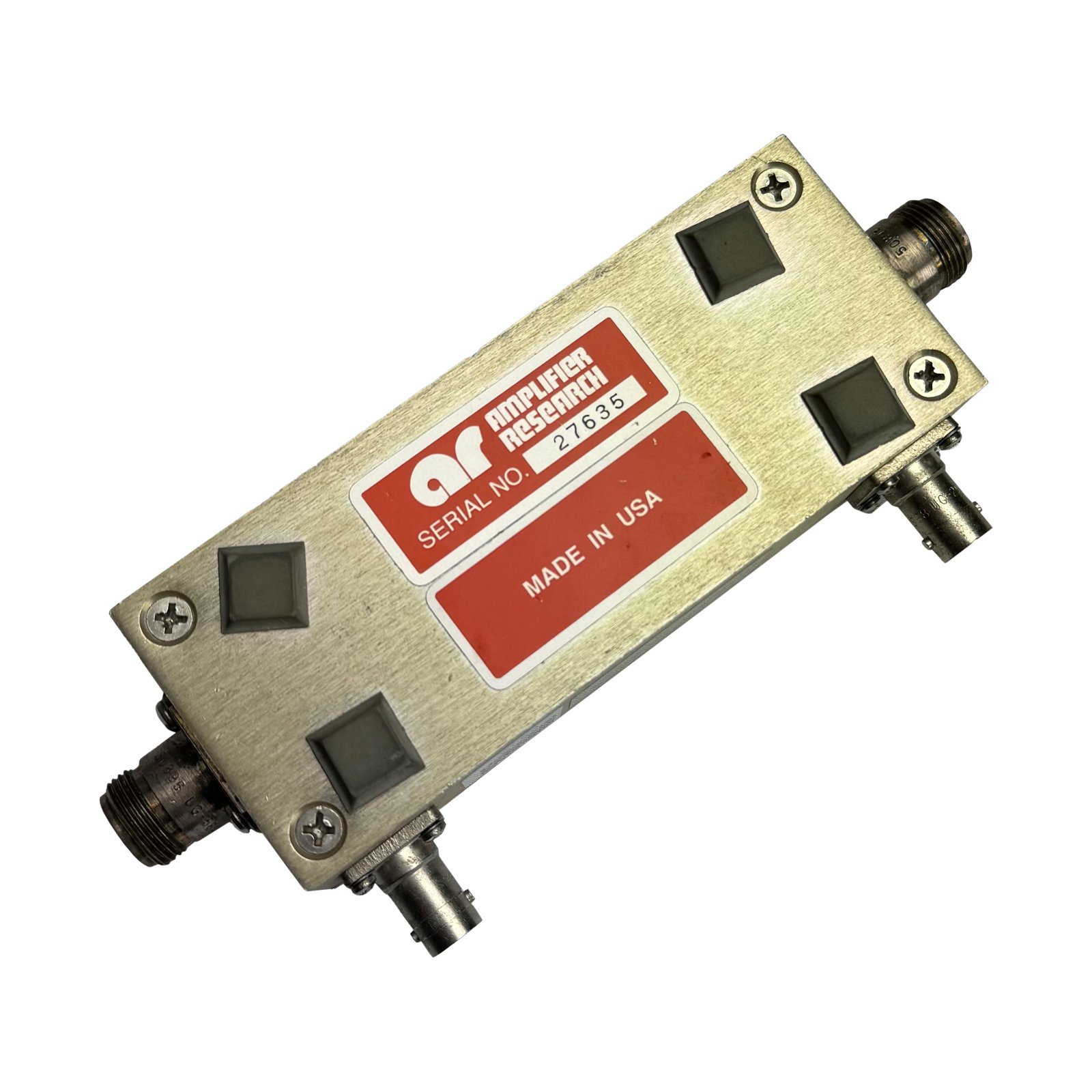

The Amplifier Research DC3010 is a dual directional coupler engineered for real-time monitoring of forward and reflected power in RF power systems. Operating across 10 kHz to 1 GHz, it delivers ultra-broadband performance with minimal insertion loss, making it ideal for integration into test benches and communication system validation platforms. The coupler handles 100 watts CW and 200 watts peak power while maintaining exceptional directivity and coupling flatness, enabling accurate power measurement via oscilloscopes, voltmeters, power meters, and spectrum analyzers.
Technical Specifications
• Frequency Range: 10 kHz to 1 GHz
• Power Handling: 100 watts CW, 200 watts peak
• Coupling Factor: 40 ± 0.8 dB (includes flatness)
• Coupling Flatness: ± 0.6 dB
• Directivity: 25 dB typical, 20 dB minimum
• Maximum Insertion Loss: 0.6 dB
• Impedance: 50 ohms
• VSWR (main line): 1.3:1 maximum
• Mainline Connectors: N(f)/N(f)
• Coupled Connectors: BNC(f)/BNC(f)
• Dimensions: 5.0 × 2.0 × 1.5 inches (12.7 × 5.1 × 3.8 cm)
• Weight: 2.0 lbs (0.9 kg)
– Key Features
• Ultra-broadband operation from 10 kHz through 1 GHz eliminates the need for multiple couplers across frequency bands
• Dual directional design monitors forward and reflected power simultaneously on isolated output channels
• Low insertion loss (0.6 dB maximum) preserves signal integrity in the main transmission line
• High directivity performance (25 dB typical) ensures accurate separation of incident and reflected components
• Compact form factor and lightweight construction simplify installation in test racks and amplifier systems
– Typical Applications
• Forward and reflected power monitoring in RF power amplifier characterization
• Integration with measurement instrumentation for compliance testing per IEC 61000-4-3 standards
• Real-time power measurement during electromagnetic immunity testing and RF system validation
– Compatibility & Integration
The DC3010 pairs directly with Amplifier Research “A” and “W” series amplifiers. Its 50-ohm mainline impedance and N-type input/output connectors ensure compatibility with standard RF test infrastructure operating within the specified frequency and power ranges.