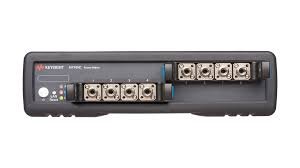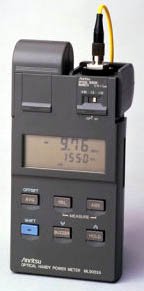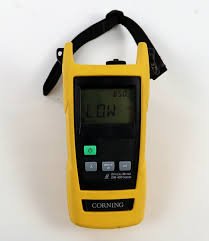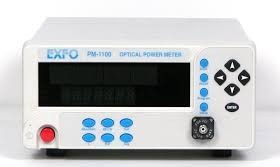


The Anritsu CMA5 Optical Loss Test Set is a pocket-sized instrument that combines a laser diode light source and InGaAs power meter in a single unit for field measurement of optical power and loss in fiber optic networks. It delivers fast, accurate loss characterization across single-mode and multimode fiber installations without warm-up time. The device integrates dual functionality—light source and power meter—into a rugged 300 g platform, eliminating the need for separate instruments during cable installation, commissioning, and maintenance operations.
## Technical Specifications
**Light Source**
• Laser diode emitter supporting SM fiber (1310 nm, 1550 nm ±20 nm) and MM fiber (850 nm, 1300 nm ±20 nm)
• Output power: –7 dBm across all wavelengths
• Spectrum width: <5 nm
• Modulation modes: CW, 270 Hz, 1 kHz, 2 kHz for fiber identification
**Optical Power Meter**
• InGaAs detector calibrated at 850 nm, 1300 nm, 1310 nm, 1490 nm, 1550 nm, 1625 nm
• Measurement accuracy: ±0.2 dBm
• Linearity: ±0.1 dB to ±0.2 dB depending on range
• Maximum input power: +23 dBm (SM type CATV), +27 dBm (standard)
• Modulation detection: 270 Hz, 1 kHz, 2 kHz
**Power & Display**
• 9 V DC @ 300 mA maximum (alkaline, dry cell, or four AA batteries)
• Battery life: 20–40 hours depending on cell type
• 4-digit, 7-segment LCD display
• Auto-zeroing capability; no warm-up time required
## Key Features
• Supports 10 μm/125 μm single-mode and 50 μm/125 μm, 62.5 μm/125 μm multimode fibers with PC-polished connectors
• FC, SC, ST, DIN, LC connector compatibility
• Class 1 laser emissions per IEC60825-1:2007 and CDRH compliance
• Operating temperature: –10°C to +50°C; storage: –25°C to +60°C
• Dimensions: 110 (W) × 210 (H) × 41.3 (D) mm
## Typical Applications
• Fiber optic cable installation verification
• Network maintenance and troubleshooting
• Loss budget validation at multiple wavelengths
• Field commissioning of SM and MM infrastructure
## Compatibility & Integration
Dual-wavelength support (SM and MM) with standardized fiber and connector types enables deployment across diverse fiber optic architectures without adapter requirements.