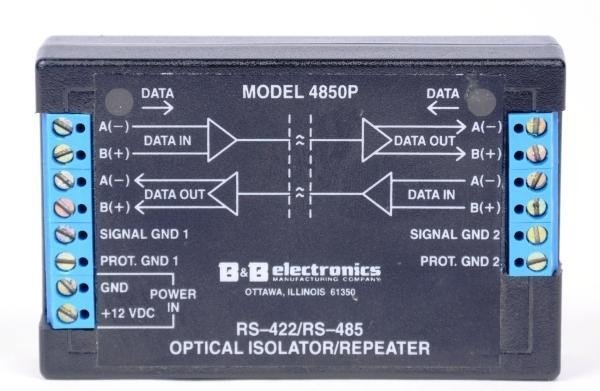

The B&B Electronics 4850PIN is an RS-485 optical isolator and repeater that protects networked equipment from ground loops and voltage surges while extending system reach. It provides 2000 VDC galvanic isolation and functions as both an isolator for single equipment protection and a repeater to overcome the 32-node RS-485 limitation. The device supports data rates up to 460.8 kbps and operates across two-wire half-duplex, four-wire half-duplex, four-wire full-duplex, and four-wire to two-wire conversion topologies, making it suitable for mixed RS-485 and RS-422 network architectures.
## Technical Specifications
**Isolation & Performance**
• Optical isolation: 2000 VDC for 1 minute
• Data rate: Up to 460.8 kbps (supports baud rates 300 bps to 115.2 kbps with adjustable timeout values)
• Power consumption: 0.7 W
• Supply voltage: 10–30 VDC or 9–14 VDC
• Operating temperature: Maximum 80°C ambient
**Electrical Interface**
• Terminal block connectors for all signal and power connections
• Isolated side: Transmit Data (A, B), Receive Data (A, B), Protective Ground, Signal Ground
• Non-isolated side: IN (+/−), OUT (+/−), Signal Ground, Protective Ground
• Built-in bias: 4.7 kΩ pull-up/down resistors on data input lines
• UL Recognized
**Physical**
• Dimensions: 2.75″ × 4.6″
• Mounting: Enclosure-based installation for industrial environments
## Key Features
• Eliminates ground loops and transient voltage surges in RS-485 networks
• Repeater functionality extends networks beyond standard 32-node limitation
• Supports mixed RS-485 and RS-422 topologies
• Four-wire to two-wire conversion capability
• Configurable termination with provision for external resistor values
• Single power supply (10–30 VDC) minimizes external components
## Compatibility & Integration
The 4850PIN integrates into existing RS-485 and RS-422 multi-drop systems as either a node isolator or segment repeater. Terminal block connectivity supports straightforward field installation. Protective ground connection is required for transient suppression; RS-485 standard topology recommends a third wire signal return path for proper operation.