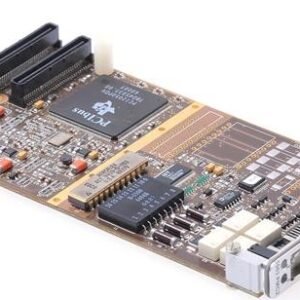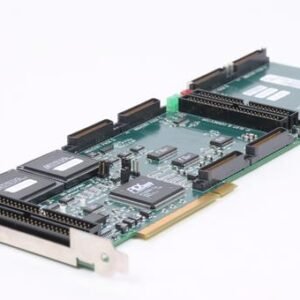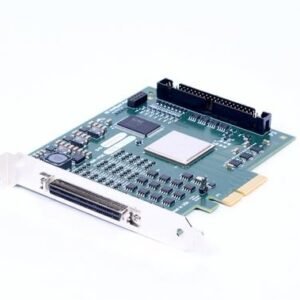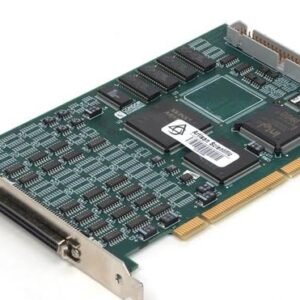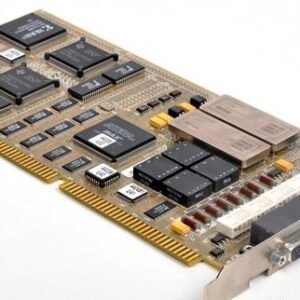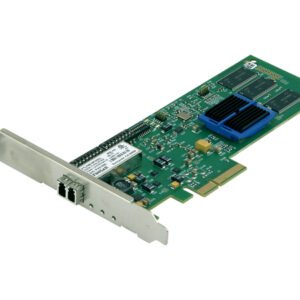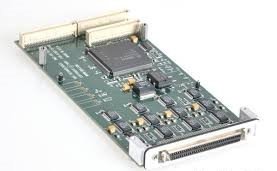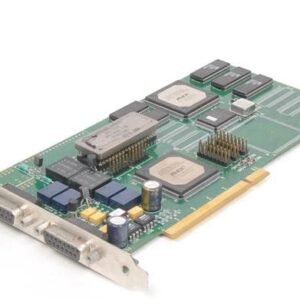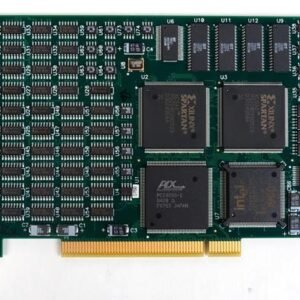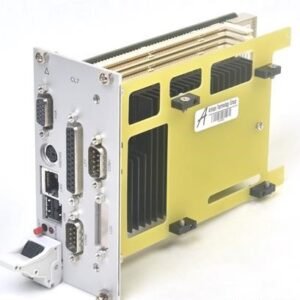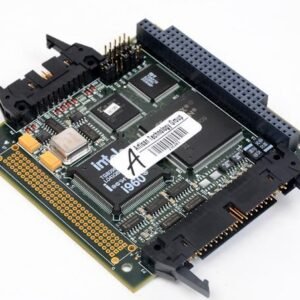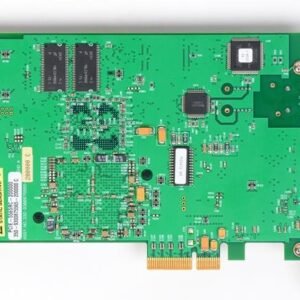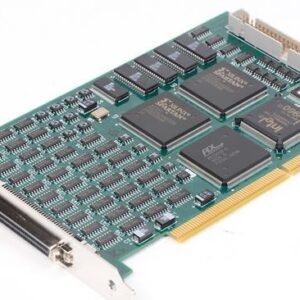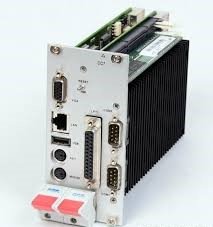
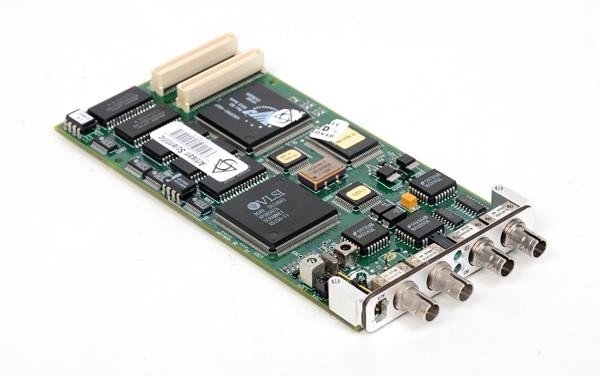

The Curtiss-Wright / Systran SCRAMNet AHPRBCPMC is a PCI Mezzanine Card (PMC) module engineered for high-speed, deterministic data communication in real-time distributed computing environments. Mounted on a short-length PCI adapter board, this card enables reliable data sharing and synchronization across multiple processing nodes with ultra-low latency characteristics suitable for aerospace, defense, and industrial automation applications.
## Technical Specifications
**Form Factor & Architecture**
PCI Mezzanine Card (PMC) on short-length PCI adapter board. Designed to PCI Local Bus Specification 2.1. Incorporates the V96xPBC PCI Bridge chip from V3 Semiconductor.
**Memory Configuration**
Factory-installed on-board shared memory available in 4 KB, 128 KB, 512 KB, 1 MB, 2 MB, or 4 MB configurations. Legacy units offer 4 KB or 128 KB with upgrade paths to 512 KB, 1 MB, 2 MB, 4 MB, or 8 MB.
**Performance**
Data throughput reaches 16.7 MB/sec. Node transport delay: 250 nSec/node.
**Network Protocol**
Backwards compatible with SCRAMNet Classic, except for GOLD Ring communication protocol.
## Key Features
• General-purpose counter functionality
• Error interrupt masking capability
• Dynamic shared-memory addressing
• Concurrent network and host access support
• Replicated shared-memory architecture for minimized latency and collision reduction between computing platforms
## Interfaces
**PCI Bus Integration**
Standard PCI environment integration via adapter board.
**Fiber Optic Media**
Related SCRAMNet products support Standard, High Density, and Low Density fiber optic configurations. GT series models feature short wavelength (850 nm) and long wavelength (1300 nm) laser interfaces supporting distances to 300 meters and 3500 meters respectively. SCRAMNet GT200 operates at 2.5 Gbit/s with SFP transceivers for up to 250 meters multimode and 10 kilometers single-mode operation.
**Coaxial Media**
Coaxial interface options available on related SCRAMNet products.
## Typical Applications
Aerospace and defense systems requiring deterministic, low-latency inter-processor communication. Industrial automation platforms demanding synchronized data distribution across distributed compute nodes.