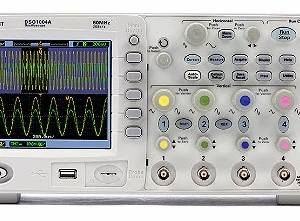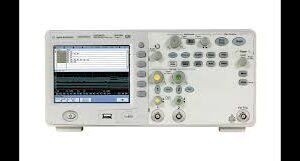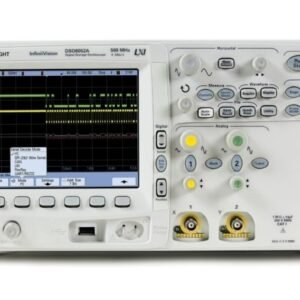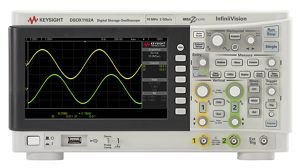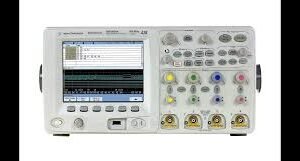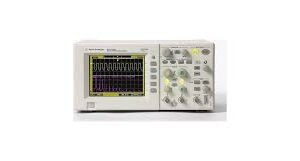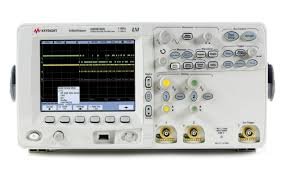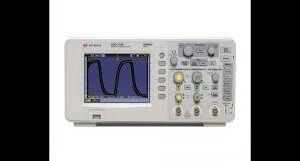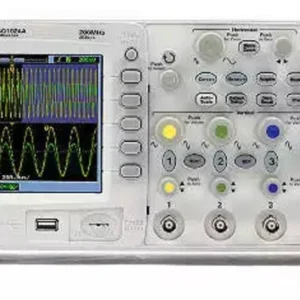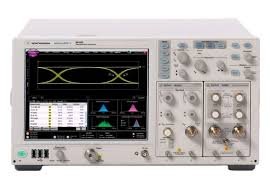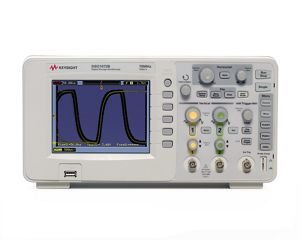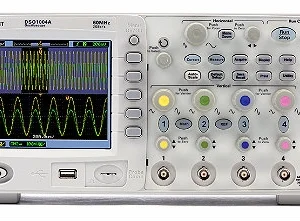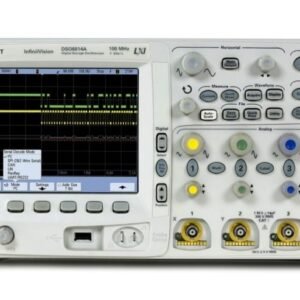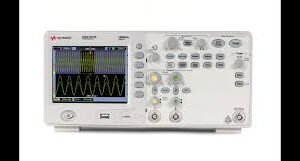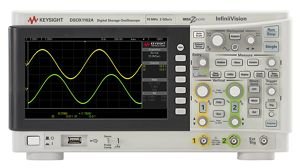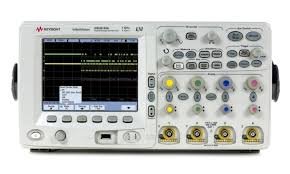

A digital oscilloscope is an electronic test instrument that captures, digitizes, and displays electrical signals as waveforms for precise analysis. Engineers and technicians use these instruments to examine amplitude, frequency, pulse width, and timing characteristics with high precision. Unlike analog oscilloscopes, digital models store waveform data, enabling detailed post-capture analysis, saving, and export to computers. They serve as fundamental tools in electronics design, troubleshooting, research, and development across multiple industries.
Technical Specifications
Bandwidth
Bandwidth defines the frequency range within which an oscilloscope accurately measures signals. It is specified at the -3 dB point, where a sinusoidal input is attenuated to 70.7% of its true amplitude. Bandwidth ranges vary from tens of MHz for basic applications to several GHz for high-speed digital, RF, and communications work. Select an oscilloscope with bandwidth at least five times the highest frequency component of interest for accurate measurements, and higher ratios for digital signals.
Sample Rate
Sample rate, measured in samples per second (Sa/s), indicates the measurement frequency of incoming signals. The Nyquist-Shannon sampling theorem requires a minimum sample rate of twice the signal’s maximum frequency. For accurate reconstruction, a rate of 2.5 times the highest frequency component is recommended for sinusoidal signals; 5–10 times is advised for complex or digital signals. Maximum sample rate may be available only when using one or two channels, with division across additional active channels.
Vertical Resolution (ADC Bits)
Vertical resolution is determined by the Analog-to-Digital Converter bit count, which establishes the smallest voltage variation the oscilloscope can accurately display. An 8-bit ADC provides 256 quantization levels. Higher bit counts—10, 12, 14, or 16 bits—deliver finer resolution and more precise measurements, particularly for weak signals and minute fluctuations.
Memory Depth (Record Length)
Memory depth specifies the quantity of waveform points captured in a single acquisition. Greater memory depth is essential for capturing longer or more complex signal sequences.
– Key Features
• Waveform capture, digitization, and real-time display
• Post-capture analysis with data storage and computer export
• High-precision measurement of signal characteristics
– Typical Applications
• Electronics design and validation
• Troubleshooting and fault diagnosis
• Research and development
• High-speed digital signal analysis
• RF and communications testing