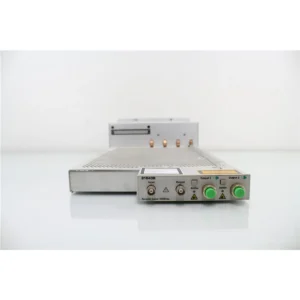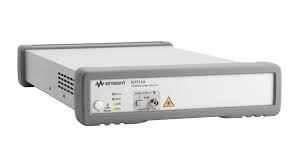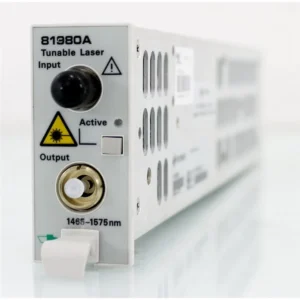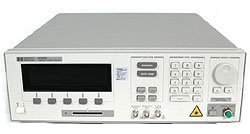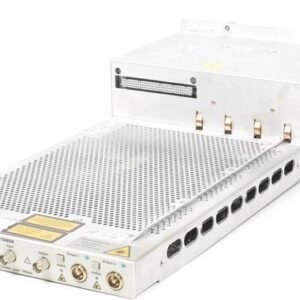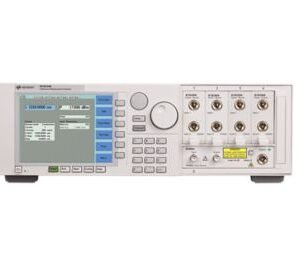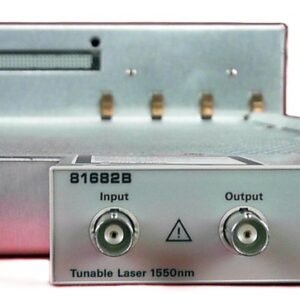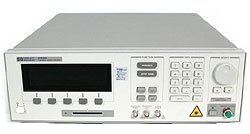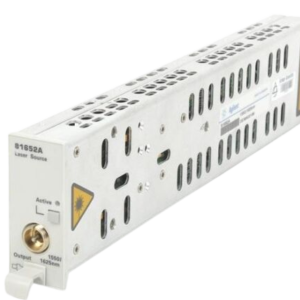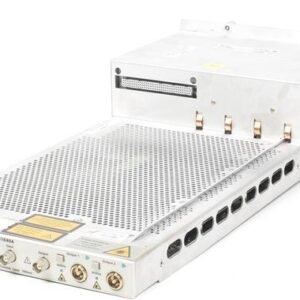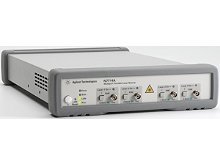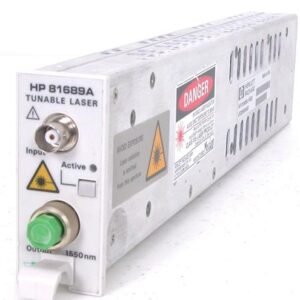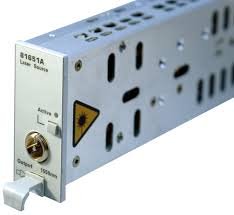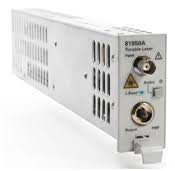
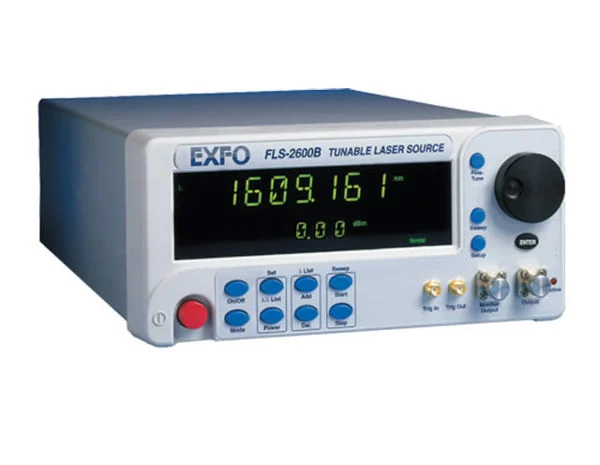

The EXFO FLS-2600B is a tunable laser source engineered for precision optical component and system testing across the C-band. It delivers fast wavelength sweeping, narrow linewidth output, and exceptional wavelength stability—essential for DWDM network development, filter characterization, and laboratory manufacturing environments.
## Technical Specifications
**Wavelength Tuning**
• Tuning range: 1510 nm to 1612 nm
• Output power: >0 dBm (1515–1610 nm); >−10 dBm (1510–1612 nm)
• Tuning resolution: 0.01 nm
• Sweep speed: Up to 50 nm/s in continuous mode
• Programmable sweep modes: Continuous and step-by-step
• Wavelength repeatability: ±2.5 pm over 10 measurements
• Wavelength stability: ±2.5 pm over 1 hour
**Optical Performance**
• Effective spectral linewidth (FWHM): Typically 700 MHz (1610 nm) to 2 GHz (1520 nm); typical 1.3 GHz
• Coherence length: Approximately 15 cm in SMF-28 fiber
• Mode-hop free across entire tuning range
• Signal-to-SSE ratio: >65 dB
• Signal-to-total-noise ratio: >45 dB
• Dynamic range: >60 dB
• Output power stability: ±0.01 dB over one hour
• Output power control: ±10 dB attenuation range with automatic level control (ALC) selectable
**Interfaces & Control**
• Front panel control and remote access via GPIB or RS-232
• SCPI command set with LabVIEW driver support
• Main output: FC/SC/E-2000 compatible connector
• Monitor output: 5% tap for real-time wavelength monitoring
• Trigger in/out: TTL-compatible for sweep synchronization
## Key Features
• Mode-hop-free operation eliminates spectral discontinuities during tuning
• Medium coherence length mitigates connector interference and parasitic reflection effects
• Naturally low spontaneous emission for clean signal integrity
• Dual control architecture supports both local and remote operation
## Typical Applications
• DWDM system design and validation
• Optical filter and component characterization
• System simulation and performance modeling
• Manufacturing test and quality assurance
## Compatibility & Integration
The FLS-2600B integrates with external instruments via trigger I/O and communicates through industry-standard SCPI protocols. LabVIEW drivers and RS-232/GPIB interfaces enable seamless integration into automated test systems.