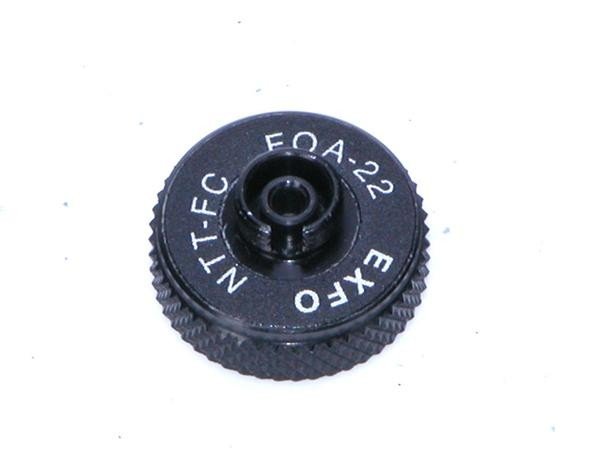

The EXFO FOA-22 is an FC fiber optic adapter designed to establish secure, repeatable connections between FC-terminated cables and EXFO test equipment. This adapter cap maintains consistent ferrule positioning at the detector interface, a critical requirement for measurement accuracy in fiber optic power and OTDR applications. The FOA-22 is engineered for standard reflection environments and incorporates design elements that minimize detector lens reflection effects on measurement repeatability.
## Technical Specifications
• **Connector Type:** FC (compatible with PC, SPC, UPC, APC, and NEC-D3 polishing finishes)
• **Input Interface:** FC Female connector
• **Output Interface:** EXFO detector port connection
• **Aperture:** Large pinhole design
• **Form Factor:** Adapter cap
• **Reflection Class:** Standard reflection applications
## Key Features
• Manufactured to strict tolerances for repeatable ferrule positioning
• Large pinhole aperture configuration reduces detector lens reflection impact
• Single-piece adapter cap design for straightforward installation
• Designed specifically for EXFO handheld power meters and OTDR equipment with integrated power measurement capability
## Typical Applications
• Handheld fiber optic power meter measurements
• OTDR testing with simultaneous power meter functionality
• Cable assembly connections requiring FC termination
• Field and laboratory fiber optic characterization
## Compatibility & Integration
The FOA-22 supports all EXFO handheld power meters including EPM-100, FPM-300, and FPM-600 models, as well as EXFO OTDRs equipped with integrated power meters. It accommodates the full range of FC connector polishing types standard in fiber optic networks. For legacy EXFO scientific instrumentation such as IQ-200 benchtop power meters, alternative FOA series adapters (FOA-2XX or FOA-3XX series) may provide optimized reflection management. The FOA series offers connector options beyond FC, including E-2000, LC, MT-RJ, MU, DIN, SMA, and Biconic types for broader system integration.