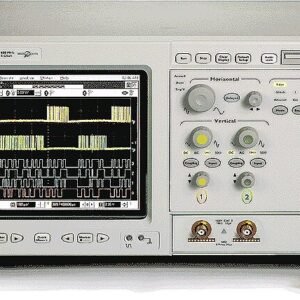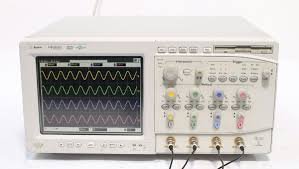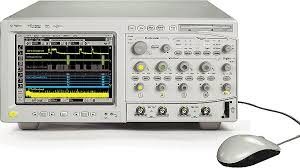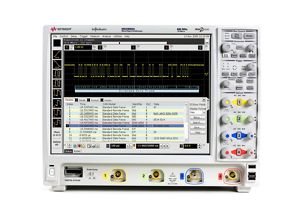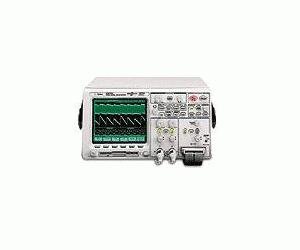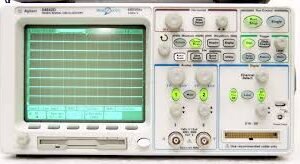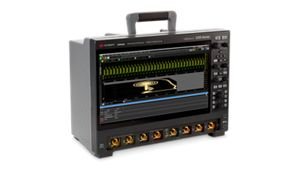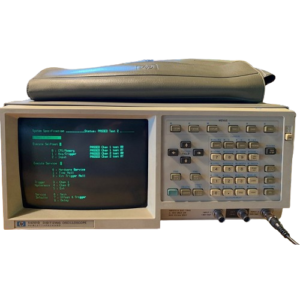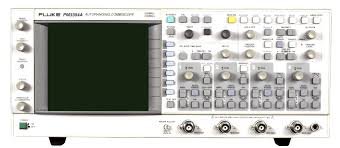

The Fluke PM 3394B Autoranging CombiScope integrates digital storage oscilloscope (DSO) and real-time analog oscilloscope functionality in a single four-channel instrument. It delivers 200 MHz bandwidth across analog and digital domains, with sampling rates up to 200 MS/s in single-channel real-time mode and 25 GS/s equivalent sampling for repetitive signals. The autoranging architecture automatically optimizes horizontal and vertical settings, while the color CRT display with cursor measurement capabilities supports vertical, horizontal, dT, frequency, ratio, and phase analysis. Mathematical functions include add, subtract, multiply, divide, and FFT, enabling comprehensive signal characterization across troubleshooting, field service, and laboratory environments.
Technical Specifications
• Bandwidth: 200 MHz analog and digital; 20 MHz bandwidth limiter @ -3 dB
• Channels: 4 analog channels
• Sampling Rate: 200 MS/s single-channel real-time; 100 MS/s dual-channel; 25 GS/s equivalent (repetitive)
• Memory: 2 CH × 16K acquisition memory
• Vertical Sensitivity: 2 mV/div to 5 V/div (1-2-5 sequence); vernier range 2 mV/div to 12.5 V/div
• Input Impedance: 1 MΩ ± 1% // 25 pF + 2 pF, or user-selectable 50 Ω ± 1%
• Dynamic Range: 100:1 @ 1 MHz; 25:1 @ 50 MHz
• Sweep Speed: 0.5 s/div to 20 ns/div (main timebase); 2 ns/div @ 10× magnification
• Vertical Resolution: 8 bits
• Trigger Sensitivity: 0.5 div; modes include auto, normal, single, external, edge, and TV (NTSC/PAL/SECAM/HDTV)
• Input Voltage Ratings: 1 MΩ position ±150 VRMS CAT II; 50 Ω position DC ±5 V / RMS 5 V / AC peak ±50 V
• Power Supply: 100–240 VAC, 50/60 Hz
– Key Features
• Dual-mode oscilloscope architecture: analog real-time + digital storage
• Autoranging and autocalibration
• Color CRT with screen readout
• Cursor measurements: vertical, horizontal, dT, 1/dT (Hz), ratio, phase
• Delayed timebase: 0.5 ms/div to 20 ns/div
• Trigger coupling options: DC, AC (<10 Hz), LF-reject (30 kHz), HF-reject (30 kHz)
– Typical Applications
• Electronics troubleshooting and diagnosis
• Signal integrity analysis
• Field service and maintenance
• Educational laboratory work
– Compatibility & Integration
• Standard Interface: RS-232
• Optional Interface: GPIB / IEEE-488.2