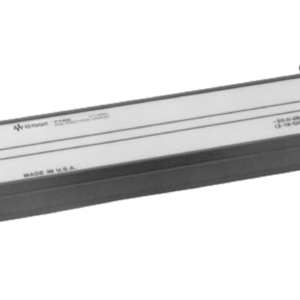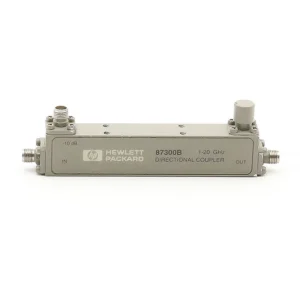
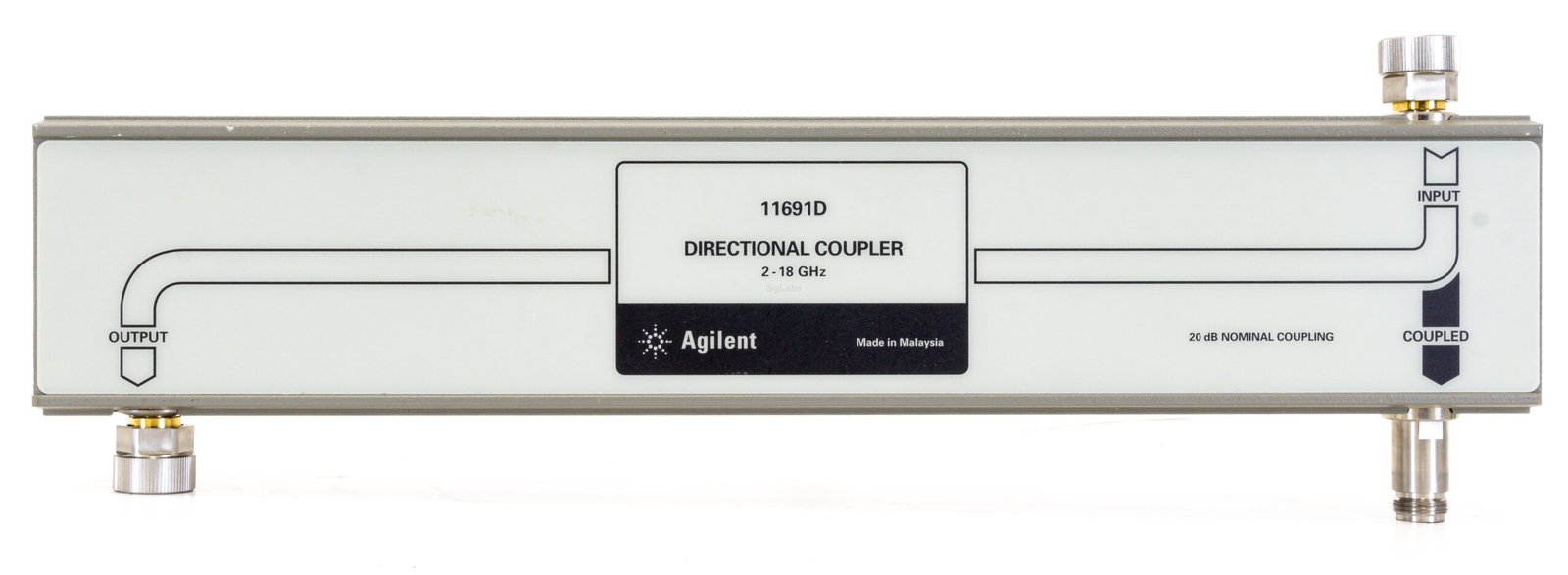

The HP/Agilent 11691D is a coaxial directional coupler engineered for precision signal sampling and isolation across 2 GHz to 18 GHz. It delivers 20 dB nominal coupling with ±1 dB maximum variation, enabling accurate broadband reflectometry and source leveling in swept-frequency measurement systems. Directivity reaches 30 dB (2–8 GHz) and 26 dB (8–18 GHz), with 24 dB achievable using Type-N input connectors. Primary line SWR stays below 1.3 from 2–12.4 GHz and 1.4 from 12.4–18 GHz, while residual loss remains under 2 dB. The coupler accepts up to 250 Ω peak power and integrates with standard APC-7 or optional Type-N connectors (MIL-C-39012/MIL-C-71). Its broad frequency span consolidates multiple single-band couplers into one platform, reducing setup complexity and calibration overhead.
Technical Specifications
• Frequency Range: 2 GHz to 18 GHz
• Nominal Coupling: 20 dB (22 dB with Option C02 Type-N connectors)
• Coupling Variation: ±1 dB across frequency
• Directivity: 30 dB (2–8 GHz); 26 dB (8–18 GHz); 24 dB with Type-N input
• Primary Line SWR: 1.3 max (2–12.4 GHz); 1.4 max (12.4–18 GHz)
• Auxiliary Port SWR: 1.3 maximum
• Primary Line Residual Loss: Less than 2 dB
• Peak Power Handling: 250 Ω
• Connector Types: APC-7 standard; Type-N optional (MIL-C-39012/MIL-C-71)
• Dimensions: 404.8 mm length
• Weight: 1.93 kg
– Key Features
• Wide 2–18 GHz coverage eliminates need for multiple single-band couplers
• Directivity specifications support high-accuracy reflection measurements
• Low residual loss preserves signal integrity in cascaded measurement chains
• Type-N connector option improves directivity to 24 dB at input port
– Typical Applications
• Broadband swept reflectometer systems requiring high directivity
• Power leveling for wideband signal sources
• Simultaneous forward power and reflection measurements
• Insertion loss and return loss characterization in swept-frequency tests
– Compatibility & Integration
The 11691D integrates with the Agilent 8755 frequency response test set and operates with RF/microwave sources and devices spanning its 2–18 GHz range. Dual-coupler configurations using the 11692D enable comprehensive two-port measurements.