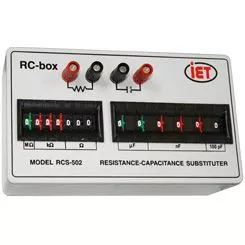

The IET Labs RCS-502 is a dual-function decade box delivering precision resistance and capacitance values in a single compact instrument. It combines 13 decades of selectable resistance (1 Ω to 10 MΩ) and capacitance (100 pF to 100 µF) with 1% accuracy across the combined range, making it essential for calibration, circuit simulation, and precision measurement across laboratory, manufacturing, and field environments.
Color-coded thumbwheel switches enable direct reading with error-proof operation—no complex manipulation required. The unit achieves exceptionally low residual values: 0.04 Ω on the lowest resistance decade and 5 pF on the lowest capacitance decade, critical for high-precision work. Housed in durable high-impact plastic with a shielded case and ground terminal, the RCS-502 withstands demanding operational conditions while maintaining accuracy.
## Technical Specifications
• **Resistance Range:** 1 Ω to 10 MΩ (13 decades)
• **Capacitance Range:** 100 pF to 100 µF (13 decades)
• **Combined Decade Range:** 0–9.999999 MΩ / 0–99.9999 µF
• **Accuracy:** 1% across combined range (0.1% to 4% depending on specific measurement)
• **Residual Resistance:** 0.04 Ω (lowest decade)
• **Residual Capacitance:** 5 pF (lowest decade)
• **Power Rating:** 500 mW
• **Dimensions:** 188 mm (W) × 110 mm (H) × 60 mm (D)
• **Weight:** 410 g
• **Protection:** 2 A fuse supplied
## Key Features
• Side-by-side, color-coded thumbwheel switches for intuitive adjustment
• Shielded case with ground terminal for noise rejection
• Independent or combined resistance/capacitance operation via shorting link
• Flexible series or parallel circuit coupling
• NIST-traceable calibration included; ISO-17025 and Z540 options available
## Typical Applications
• Equipment calibration and verification
• Circuit simulation and prototype development
• Timer, oscillator, and filter tuning
• Automated test systems and manufacturing quality control
• Field measurements and on-site diagnostics
• Educational demonstrations and research
## Compatibility & Integration
Resistance and capacitance circuits operate independently, in series, or in parallel. A shorting link allows seamless coupling or isolation of the two measurement domains.