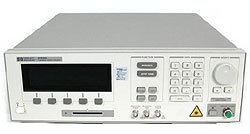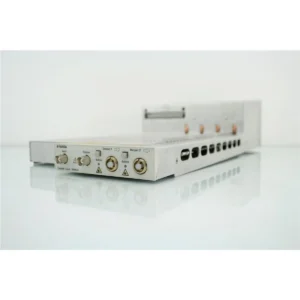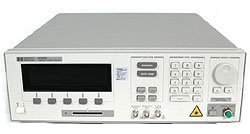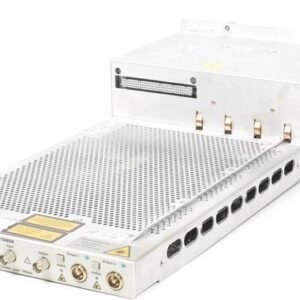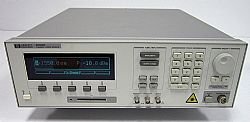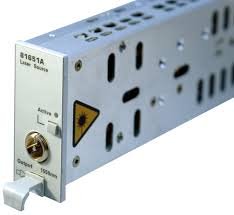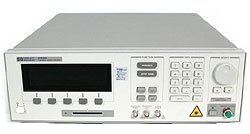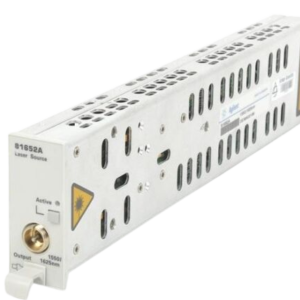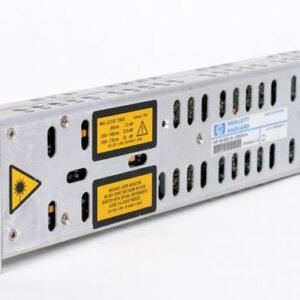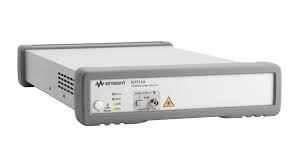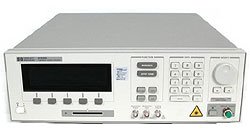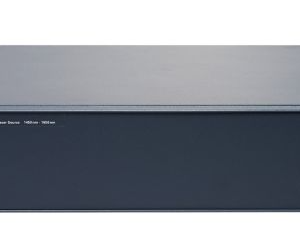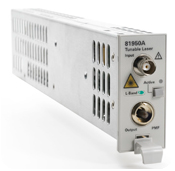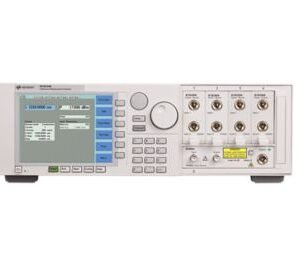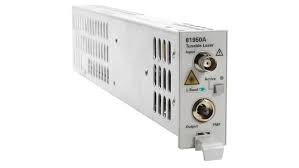
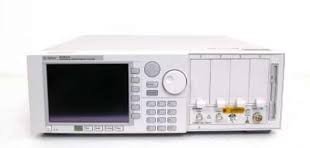

The Keysight 8164A Lightwave Mainframe paired with the 81682A Tunable Laser Source delivers a modular platform for optical component characterization across the C-band. The 8164A mainframe accepts one tunable laser source module plus four additional compact optical modules, enabling flexible test configurations. The 81682A provides mode-hop free tuning across 1460 nm to 1580 nm with ±0.01 nm absolute wavelength accuracy and ±0.5 pm repeatability, making it well-suited for DWDM component validation and optical system development.
## Technical Specifications
**81682A Tunable Laser Source**
• Wavelength range: 1460 nm to 1580 nm (C-band)
• Maximum output power: +8 dBm
• Output power (1520–1570 nm): >+4.5 dBm
• Wavelength accuracy (absolute): ±0.01 nm
• Wavelength repeatability: ±0.5 pm (typical)
• Wavelength resolution: 0.1 pm
• Dynamic range: >60 dB (via optional built-in attenuator)
**8164A Mainframe**
• Slots: 1 dedicated TLS slot + 4 module slots
• Display: Graphical color display, 600 × 400 pixels
• Interfaces: GPIB, RS-232C serial, Centronics parallel, VGA, PS/2, PCMCIA 2.1
• Storage: 2000 MB internal HDD plus ATA/SRAM card support
• Power: 100–240 VAC ±10%, 48–66 Hz, 120–280 VA max
• Operating temperature: +10°C to +35°C
• Storage temperature: −40°C to +70°C
• Humidity: <80% R.H. (non-condensing)
## Key Features
• Mode-hop free tuning for continuous wavelength scanning
• Extensive triggering with configurable hardware I/O ports
• Passive component test, stability logging, and data acquisition built-in
• PC Card slot enables field data transfer and firmware updates
• Supports all 8153A and 8163A series optical modules for multifunction measurement capability
## Typical Applications
• DWDM filter and multiplexer characterization
• Tunable laser source validation and stability testing
• Wavelength-dependent optical component measurement
• Manufacturing test environments requiring automated scanning
## Compatibility & Integration
The 81682A mounts directly into the 8164A mainframe. Additional optical modules—power meters, return loss modules, fixed sources, attenuators, and optical switches—occupy the four remaining slots. Remote control via GPIB or RS-232C enables integration into automated test systems.