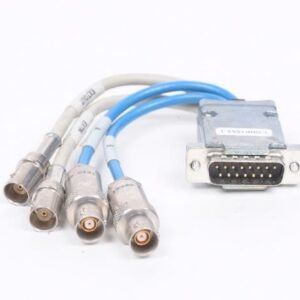
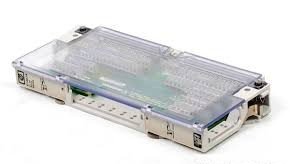

The Keysight/Agilent/HP E1467-80010 is a screw terminal block accessory that interfaces with the E1467A QUIC relay matrix module. It provides the connection point for external wiring to the E1467A, enabling signal routing in automated test and measurement systems. The terminal block uses the QUIC (Quick, Universal, Interface Connector) new-style interface and determines the matrix configuration topology.
Technical Specifications
-# Interface and Connectivity
• Interface Type: QUIC (Quick, Universal, Interface Connector) new-style terminal block interface
• Terminal Type: Screw terminal block for external wiring connections
• Primary Module Compatibility: E1467A Relay Matrix Switch Module (C-size, 1-slot, register-based VXI module)
-# Matrix Architecture
• E1467A Configuration: 8×32 two-wire switching matrix with latching armature relays
• Associated Modules: Shares switch card with E1465A and E1466A relay matrix modules
– Key Features
• Pluggable terminal block design enables topology reconfiguration without hardware redesign
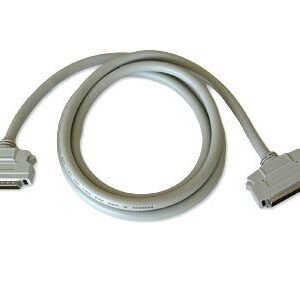
• Supports matrix expansion through interconnection of multiple E1467A modules using chaining cables (such as E1466-80002)
• Allows creation of larger matrix configurations (e.g., 8×96 matrix using multiple E1467A modules)
• Terminal block selection directly determines row and column matrix topology
• Latching armature relay technology provides stable signal switching
– Typical Applications
• Automated test system signal routing and switching
• Multi-channel relay matrix expansion in VXI-based test platforms
• Production and design verification testing requiring flexible switching topologies
• Systems requiring reconfigurable two-wire signal switching matrices
– Compatibility & Integration
The E1467-80010 terminal block integrates directly with E1467A modules and works in conjunction with associated E1465A and E1466A relay matrix modules that share the same switch card architecture. Matrix expansion is achieved by chaining multiple modules together, with terminal block configuration determining the overall switching topology. This modular approach allows test engineers to scale matrix size and adapt switching configurations to specific application requirements.