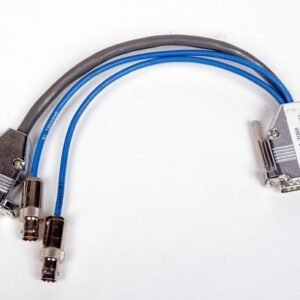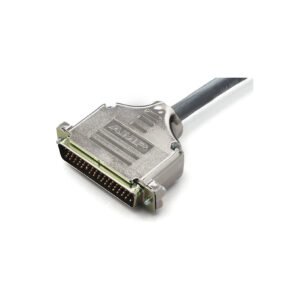

The Lauterbach LA-7742 and LA-7765X are standard 20-pin JTAG debugger cable connectors that establish reliable host-to-target communication for embedded system debugging and programming. These connectors interface with Lauterbach’s TRACE32® debugging platform via the JTAG protocol (IEEE Std 1149.1), enabling code download, breakpoint configuration, memory inspection, and single-step execution across a wide range of target processors.
Technical Specifications
Connector Interface
• 20-pin double-row connector with 2.54 mm (0.100 inch) pin spacing
• IDC female polarized socket connector (Tyco/T&B part 1-1658526-3 or 609-2041)
• Requires male 20-pin double-row connector on target board
• Shrouded housing with center polarization recommended for target connector
• Adapter solutions available for MIPI, XILINX, TI, Altera, and RISC-V targets
Electrical Characteristics
• Supported voltage range (pre-September 2009 cables): 1.8V to 5.5V
• Supported voltage range (September 2009 and later): 0.9V to 5.5V
• LA-7742 ARM9 core support: 0.4V to 5V
• Reference voltage (VTREF) pin auto-adjusts output driver levels and establishes logic-level comparator reference
• VTREF must connect to target I/O voltage (e.g., 3.3V for 0V to 3.3V signal swing)
Pull-up/Pull-down Requirements
• TCK (JTAG Clock): pull-down to GND recommended
• TMS (Standard JTAG): pull-up to VTREF recommended
• TMSC (Compact JTAG): target device bus-hold required
• TDI (JTAG TDI): pull-up to VTREF recommended
• TRST-/SRST- (active-low reset): open-drain drive; 47 kΩ pull-up in cable; target-side pull-up (1 kΩ to 47 kΩ) may be required
• RTCK (Return Clock): no pull-up or pull-down required
– Key Features
• Supports multiple voltage standards without external level translation
• Stable reference voltage ensures consistent output driver performance
• Active-low reset with configurable pull-up topology
• Compatible with diverse processor architectures and target connector types
– Typical Applications
On-chip debugging, firmware development, memory access verification, and processor initialization across ARM, XILINX, TI, Altera, and RISC-V platforms.
– Compatibility & Integration
Integrates with TRACE32® debugging framework. Standard 20-pin interface accommodates various target topologies through available converter and adapter solutions.