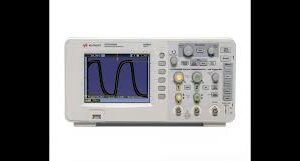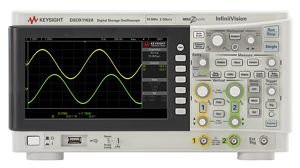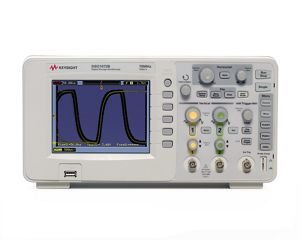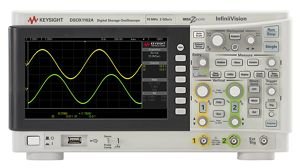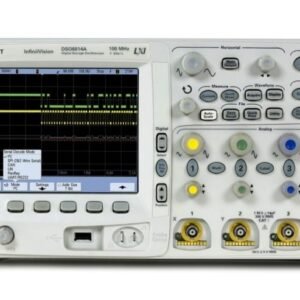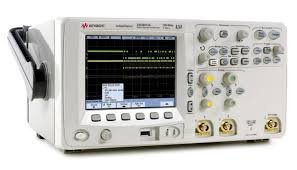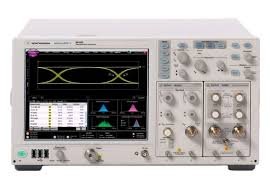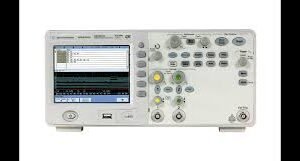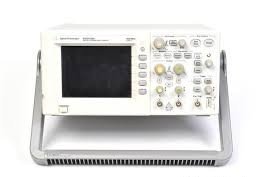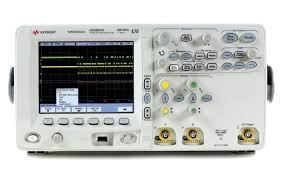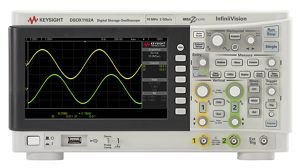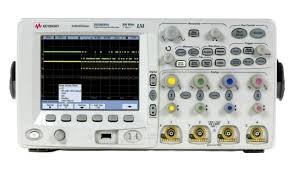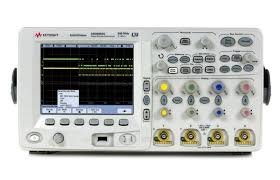

The LeCroy 9450 is a dual-channel digital oscilloscope delivering 300 MHz bandwidth with sampling rates up to 400 MS/s for transient capture and 10 GS/s for repetitive waveforms via random interleaved sampling. The instrument combines 8-bit vertical resolution, extended memory segmentation, and sophisticated triggering architecture to support signal acquisition and analysis across telecommunications, electronic design, laser systems, computer hardware, non-destructive testing, and defense applications.
Technical Specifications
• Bandwidth: 300 MHz
• Channels: 2
• Sampling Rate: 400 MS/s (transients); 10 GS/s (repetitive, random interleaved sampling mode)
• Vertical Resolution: 8-bit ADCs
• Vertical Sensitivity: 5 mV/div to 2 V/div
• Input Impedance: 1 MΩ (≈11 pF) or 50 Ω ±1%
• Time Base Range: 1 nsec/div to 5000 sec/div
• Time Base Accuracy: ±(0.01% + 500 ps)
• Clock Accuracy: ±0.002%
• Acquisition Memory: 50 k words per channel (non-volatile, battery-backed minimum 2 years); segmentable into 2, 5, 10, 20, 50, 100, or 200 segments
• Reference Memories: 50 k words (16-bit), channels C and D
• Waveform Storage Memory: 200 k
• Trigger Sensitivity: 1 div p-p (DC to 300 MHz)
– Key Features
• Advanced triggering: SMART, FASTGLITCH (≤2.5 nsec), state qualified, logic, TV, width-based, time/event qualified
• Independent trigger circuits for CH1, CH2, and EXT with individual slope, coupling, and level controls
• Trigger hold-off and delay by time or event count
• Trigger timing logged at 0.1 sec absolute or nanosecond relative resolution
• Pulse parameter analysis: twenty automatic measurements (risetime, falltime, RMS voltage, etc.)
• Summation averaging up to 1000 sweeps
• Dual Zoom mode with expansion to 1000×
• Mathematics: add, subtract, invert
• Optional FFT and extended signal processing packages
– Typical Applications
Telecommunications, electronic design and test, laser systems, computer hardware characterization, non-destructive testing, physics research, and defense applications.
– Compatibility & Integration
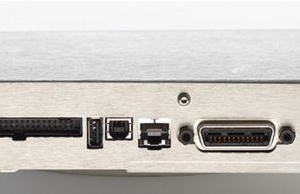
Independent trigger outputs and veto inputs (BNC connectors) enable instrument synchronization and external logic integration.