
The LeCroy LT374M is a four-channel digital storage oscilloscope built for precision waveform analysis in research, design validation, and field diagnostics. This 500 MHz instrument delivers up to 4 GS/s single-shot sampling on one or two channels, 1 GS/s across three or four channels, and 50 GS/s RIS capability for repetitive signals. With 500 kpts acquisition memory per channel and selectable 1 MΩ or 50 Ω input impedance, it captures transient events and sustained measurements across vertical ranges from 2 mV/div to 10 V/div. Enhanced resolution mode extends vertical precision to 11 bits, while dual timebase operation—including zoom capability—spans 500 ps/div to 1000 s/div. The instrument triggers on edge, glitch, width, TV, interval, dropout, and pattern conditions up to 500 MHz. A 9-inch color CRT provides real-time display, and integrated math functions enable on-board signal processing. Segment acquisition mode supports 2 to 1,000 captures with 50 µs intersegment timing for multi-event recording.
Technical Specifications
• Analog Bandwidth: 500 MHz (-3 dB)
• Single-Shot Sample Rate (1–2 channels): 4 GS/s
• Single-Shot Sample Rate (3–4 channels): 1 GS/s
• RIS Sample Rate: 50 GS/s (repetitive signals)
• Memory Depth: 500 kpts per channel (4 channels); expandable options available
• Vertical Resolution: 8 bits standard; up to 11 bits with ERES
• Vertical Sensitivity: 2 mV/div to 10 V/div
• Input Impedance: 1 MΩ || 12 pF or 50 Ω
• DC Gain Accuracy: ± (1.5% + 0.5% of full scale)
• Offset Accuracy: ± (1.5% + 0.5% of full scale + 1 mV)
• Maximum Input (50 Ω): 5 Vrms
• Maximum Input (1 MΩ): 400 Vmax (DC + peak AC ≤ 5 kHz)
• Timebase Range: 500 ps/div to 1000 s/div
• Trigger Types: Edge, glitch, width, TV, interval, dropout, pattern
• Maximum Trigger Frequency: 500 MHz
• Sequence Mode: 2 to 1,000 segments; 50 µs intersegment time maximum
• Bandwidth Limits: 20 MHz or 200 MHz selectable
• Channel Isolation: >250:1 at ≤500 MHz; >100:1 at 1 GHz
– Key Features
• Four independent input channels with AC/DC/GND coupling options
• Simultaneous multi-timebase and zoom trace operation
• Integrated waveform math and analysis functions
• Hardware bandwidth limiting to reduce noise in low-frequency measurements
• Sequence acquisition for capture of non-contiguous events
– Connectivity & Integration
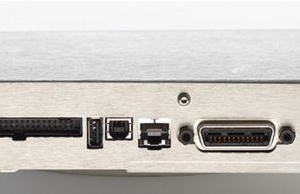
• RS-232, GPIB, and Centronics interfaces (Ethernet available as option)
• Remote control and data transfer capabilities