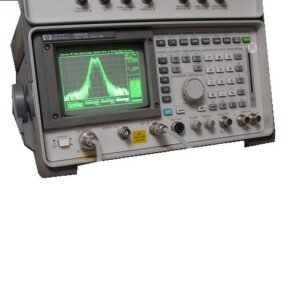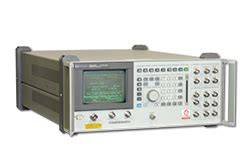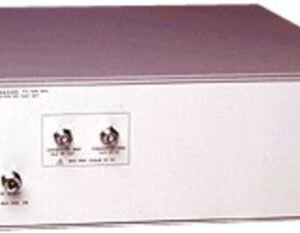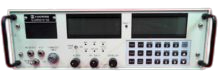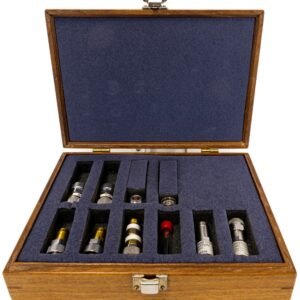

The Marconi IFR Aeroflex 2968 is a single-box TETRA radio test set for design, manufacturing, and field maintenance of TETRA terminals and base stations. It emulates live TETRA network environments, enabling devices under test to register and operate as if connected to a live network. The instrument supports trunked and direct modes, simplex and duplex operations, and all standard TETRA call types including group, individual, phone, and emergency calls.
Technical Specifications
Frequency Coverage
• Operating range: 10 MHz to 1 GHz, usable to 1.15 GHz
• Resolution: 1 Hz
• RF Absolute Frequency Error Meter (Base Station and Direct Mode): 10 MHz to 1 GHz with ±500 Hz error range, 0.1 Hz resolution, ±15 Hz accuracy
Modulation & Signal Quality
• Error Vector Magnitude (EVM): Typically <3% RMS, <6% peak
Receiver Measurements
• TETRA Test (TT) registration and TT RF loopback for Bit Error Rate (BER), Message Erasure Rate (MER), and Residual Bit Error Rate (RBER)
• T1 test mode with BER loopback; MER and BER measurement via T1 signals
• Supported T1 signal types: TCH/7.2 type 1, TCH/2.4 type 4, SCH/F type 2
Transmitter Measurements
• Burst power, power profile, frame alignment (burst timing error), frequency error, modulation accuracy (EVM), and residual carrier
• Numerical and graphical display for all TETRA burst types
• Demodulated symbol data capture and output for offline analysis
– Key Features
• TIPv3 compliance with Part 1 Core Services: Registration, Individual Call, Group Management, Group Call, Emergency Call, Cell Re-Selection, SDS Status, Telephone Call (TTR 001-1 v3.0.13)
• TIPv4 Part 6 Air Interface Migration: Terminal registration regardless of country code (MCC) and network code (MNC) mismatch
• TIPv4 Part 8 Testing Requirements support
• Short Data Service (SDS-TL) text messaging (TTR 001-2 v1.0.11)
• Direct or Hook signalling
• User-defined call types
• Mobile-originated and mobile-terminated call support
– Typical Applications
• TETRA terminal acceptance testing and commissioning
• Base station validation and alignment
• RF performance troubleshooting
• Receiver sensitivity verification
• Transmitter compliance measurement
– Compatibility & Integration
Fully compliant with TETRA standards TTR 001-1, TTR 001-2, and TTR 001-8. Supports automatic equipment class identification and RF loopback for sensitivity characterization.