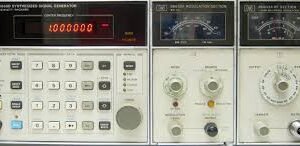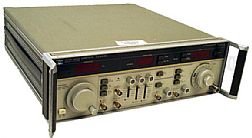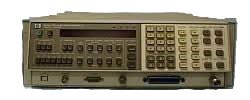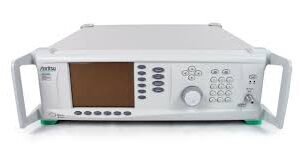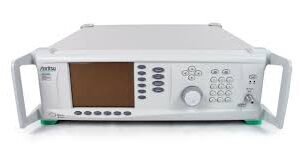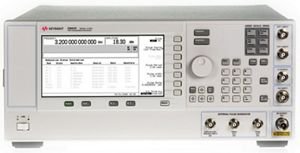

The Marconi IFR Aeroflex 6815R is a 40 GHz signal generator engineered for RF and microwave testing, calibration, and characterization of complex systems including mixers and frequency converters. Operating from 10 MHz to 40 GHz with 1 Hz resolution, it delivers output power from -110 dBm to +20 dBm with 0.1 dB resolution and leveled power performance across its operating range. The instrument supports comprehensive modulation modes: FM (internal and external), pulse modulation, AM, phase modulation, and FSK, with modulation frequencies spanning 0.1 Hz to 500 kHz for sinewave modulation and 3 dB FM bandwidth to 10 kHz. Pulse modulation achieves on/off ratios better than 40 dB with rise times under 10 µs. AM depth reaches 99.9% with 0.1% resolution. Harmonic content is typically better than -50 dBc to -55 dBc through internal filtering.
Technical Specifications
• Frequency Range: 10 MHz to 40 GHz
• Frequency Resolution: 1 Hz
• Output Power: -110 dBm to +20 dBm; Levelled Power Range: -10 dBm to +4 dBm (20–24 GHz), -10 dBm to 0 dBm (24–40 GHz)
• Output Power Resolution: 0.1 dB
• FM Deviation Accuracy: ±5% of indication ±1 Hz (excluding residual FM)
• Amplitude Modulation: Depth to 99.9% with 0.1% resolution
• Pulse Modulation: On/off ratio >40 dB; rise time <10 µs
• Harmonics: Typically -50 dBc to -55 dBc
• Step Time: 300 ms (<20 kHz at 10 MHz–3 GHz, <200 kHz at 3–46 GHz); 1 ms (<1 kHz, <10 kHz); 10 ms (<1 kHz, <4 kHz); List Mode <500 µs (10 MHz–3 GHz), <100 Hz (3–46 GHz)
– Key Features
• CW, swept, and CW list modes with up to 1024 frequencies
• ALC leveling system for external modulation input (0.75–1.25 V RMS)
• GPIB and RS-232 interfaces for ATE integration
• TTL trigger capability with optional trigger board
• Operating Temperature: +5°C to +45°C
• Auto-sensing power supply: 90–265 V, 45–65 Hz AC
– Compatibility & Integration
GPIB and RS-232 control enable seamless integration with automated test environments. TTL triggering via menu softkey, GPIB, RS-232, or external source supports flexible test sequencing. Frequency lists store in internal memory or floppy disk.