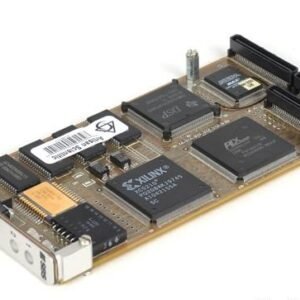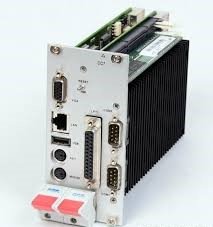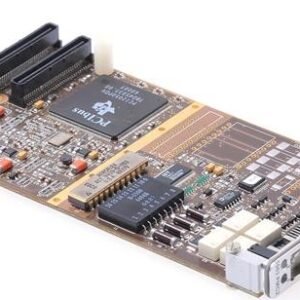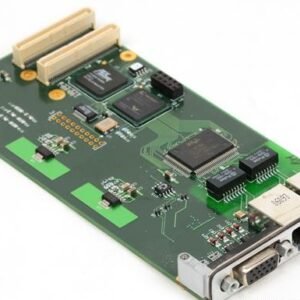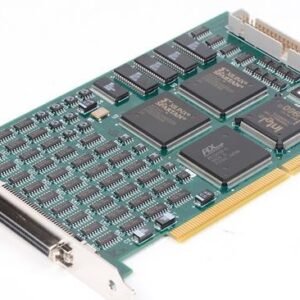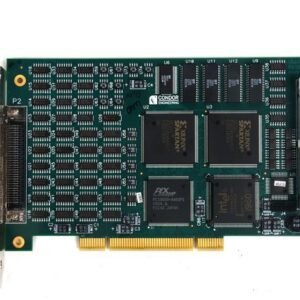

The Microspace/Digital-Logic MSM586SEN is a PC/104 single board computer engineered for embedded applications demanding compact, stackable processing in space-constrained environments. Built around the ELAN520 processor running at 133 MHz, this SBC integrates ISA/PCI bus architecture with configurable serial interfaces, IDE storage support, and onboard networking—making it well-suited for industrial control, data acquisition, and distributed communication systems.
Technical Specifications
• Processor: ELAN520 at 133 MHz
• Memory: 32 MB or 64 MB soldered DRAM
• Bus Architecture: ISA/PCI compatible
• Expansion Interface: ISA via PC/104 connector
• Storage Interfaces: IDE P-ATA (LB), DiskOnChip socket, Floppy Disk
• Serial Ports: Up to 4 COM ports (COM1–COM2 configurable as RS232C, RS422/485, or TTL)
• Parallel Port: LPT1
• Network Interface: 10/100 BASE-T LAN
• Real-Time Clock: Onboard with battery backup
• Watchdog Timer: Programmable
• Keyboard/Mouse Connectors: Standard PC-compatible ports
• Form Factor: 90 × 96 mm (3.550 × 3.775 inches)
• Year 2000 Compliance: Verified
– Key Features
• Soldered DRAM eliminates module insertion variability and improves reliability in vibration-prone environments
• DiskOnChip socket provides solid-state boot capability without mechanical storage
• ISA expansion slot enables integration of custom I/O and sensor modules via the PC/104 stackable architecture
• Configurable serial interfaces support legacy RS232C, differential RS422/485, and TTL signaling on individual ports
• Passive thermal design—no active cooling required for standard industrial temperature ranges
– Typical Applications
• Industrial automation and process control
• Distributed data acquisition networks
• Embedded communication gateways
• Legacy system integration and modernization
– Compatibility & Integration
Fully adheres to PC/104 Consortium standards, enabling straightforward stacking of compatible I/O and functional modules. ISA bus architecture supports a broad ecosystem of third-party expansion cards. Floppy, IDE, and DiskOnChip boot options provide flexibility for different deployment scenarios.