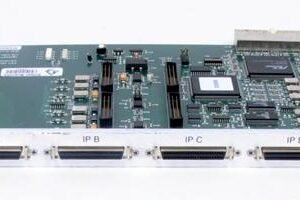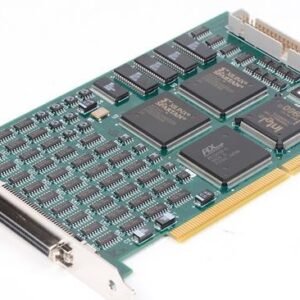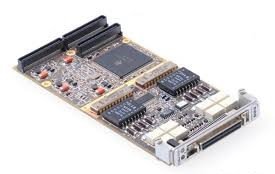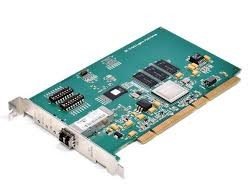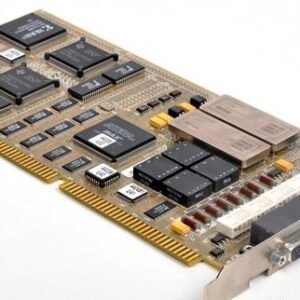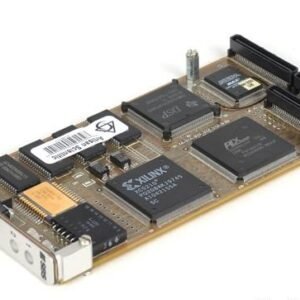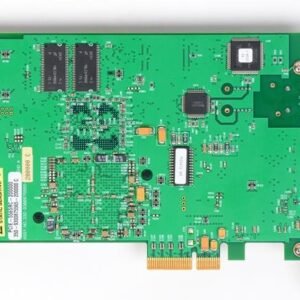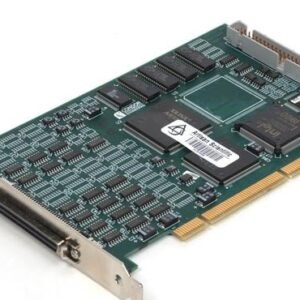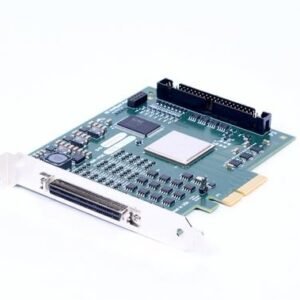

The National Instruments PCI-GPIB/LP is a low-profile GPIB interface card for PCI bus systems, delivering high-speed instrument control and data acquisition in compact form factor. It connects directly to standard IEEE 488 instruments via a 24-pin GPIB connector and operates in both 3.3 V and 5 V PCI slots without external power. Built on proven PCI-MITE and TNT ASICs, this card combines IEEE 488.1 and High-Speed GPIB (HS488) protocol support for flexible test automation and measurement applications.
Technical Specifications
Data Transfer Performance
• IEEE 488.1 3-wire interlocked handshake: up to 1.5 MB/s
• High-Speed GPIB (HS488): up to 7.7 MB/s
Power Consumption
• +5 V rail: 300 mA typical; 450 mA maximum
• Total: approximately 600 mA under typical operation
• Power sourced directly from PCI slot—no external supply required
Physical & Environmental
• Form factor: Low-profile PCI card, 12 cm × 6.44 cm (4.87 in. × 2.54 in.)
• Operating temperature: 0 °C to 55 °C
• Operating humidity: 10% to 90% noncondensing
• Storage temperature: -20 °C to 70 °C
• Storage humidity: 5% to 95% noncondensing
– Key Features
• PCI-MITE ASIC: Full PCI Specification 2.1 compliance
• TNT ASIC: IEEE 488 and IEEE 488.2 Talker, Listener, and Controller functionality
• Integrated FIFO buffers decouple PCI and GPIB transfers for sustained throughput
• Universal PCI connector supports both 3.3 V and 5 V slots
• Fully software-configurable plug-and-play installation
• Single GPIB connector via Micro D-Sub with standard converter cable
– Typical Applications
• Automated instrument control and test systems
• Data acquisition from GPIB-compatible devices
• High-speed measurement and characterization workflows
• Laboratory and manufacturing test environments
– Compatibility & Integration
The PCI-GPIB/LP integrates into any PCI-based host system with no external power dependencies. Its functional equivalence to the standard PCI-GPIB card with reduced footprint makes it ideal for space-constrained applications while maintaining full IEEE 488 protocol support.