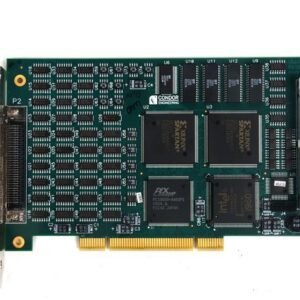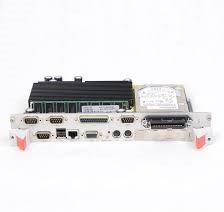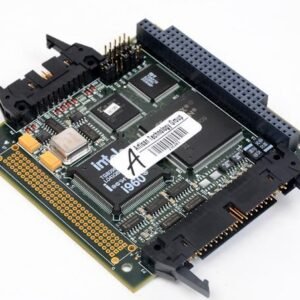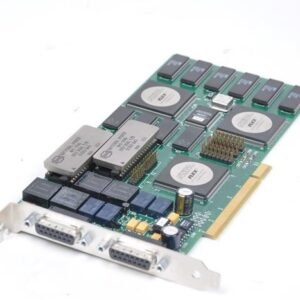

The NI roboRIO is a real-time embedded controller built on a Xilinx Z-7020 All Programmable SoC with dual-core ARM Cortex-A9 processor running at 667 MHz or 866 MHz. It combines a general-purpose processor with an FPGA to deliver deterministic control, data acquisition, and signal processing for robotics platforms. The system runs NI Linux Real-Time OS and supports multiple programming languages including LabVIEW, Java, C++, C# .NET, Visual Basic .NET, and MATLAB, making it accessible to diverse development teams.
Technical Specifications
• Processor: Xilinx Z-7020 dual-core ARM Cortex-A9 at 667 MHz or 866 MHz
• Memory: 256 MB DDR3 RAM; 512 MB non-volatile (inaccessible); 4 GB microSD (accessible)
• Operating System: NI Linux Real-Time
• Ethernet: 10BaseT and 100BaseTX (IEEE 802.3), 10/100 Mbps or auto-negotiated; max 100 m/segment
• USB: 2× USB 2.0 Hi-Speed Host, 1× USB 2.0 Hi-Speed Device; max cable length 5.0 m
• Serial: 1× RS-232 at up to 230,400 bps; UART at 3.3V TTL on MXP
• Digital I/O: 26 total lines (10 dedicated + 16 on MXP); 5 V input compatible, 3.3 V output; secondary functions include SPI (4 MHz), I²C (400 kHz), PWM, quadrature encoder
• Analog Input: 8 single-ended channels (4 integrated + 4 MXP), 12-bit resolution, 500 kS/s aggregate, 0 V to +5 V range, overvoltage protection to ±16 V
• Analog Output: 2 single-ended channels on MXP
– Key Features
• Real-time FPGA co-processor for deterministic signal processing and control
• Multi-language support including LabVIEW, Java, C++, and MATLAB
• Mixed-signal I/O with analog and digital acquisition simultaneously
• MicroSD expansion for boot images and application storage
– Typical Applications
• FIRST Robotics Competition (FRC) platforms
• Educational robotics and autonomous systems
• Research-grade control and data acquisition
– Compatibility & Integration
Standard Ethernet for network control and file transfer. USB host ports for peripheral connectivity. RS-232 serial for legacy instrument control. FPGA enables custom logic for protocol implementation and real-time determinism.