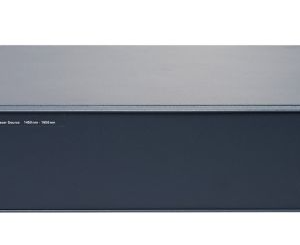
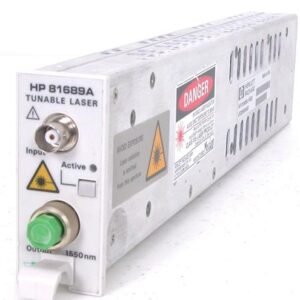
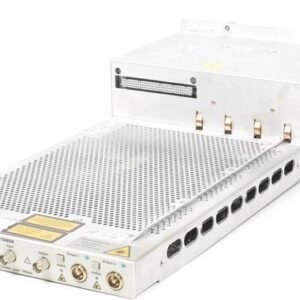
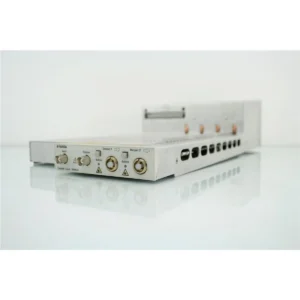
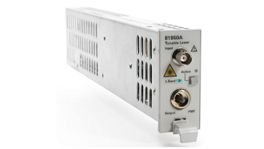
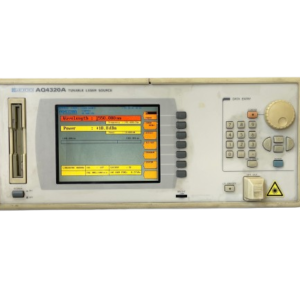
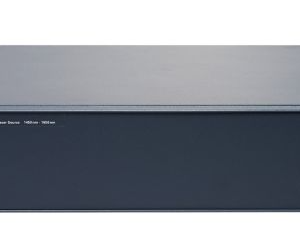
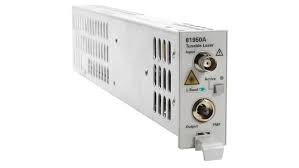
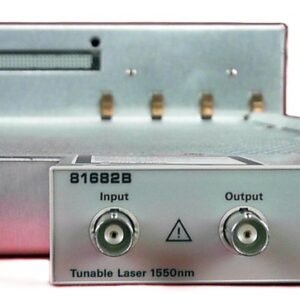
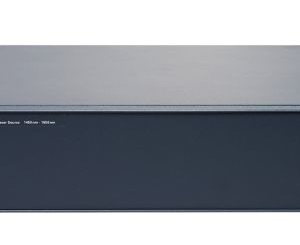
The Photonetics 3610RA00 System 1536-1565 is an 8-slot optical mainframe designed to integrate multiple tunable laser sources, amplifiers, and optical components into a single platform. This modular system accepts ECL tunable lasers, DFB lasers, ASE sources, EDFA amplifiers, laser diodes, optical switches, and attenuators, enabling flexible configurations for DWDM testing, fiber component characterization, and precision optical metrology. The platform supports module wavelength ranges spanning 1260–1680 nm and provides centralized control via GPIB and RS-232 interfaces with individual and remote laser output interlocks for safety compliance.
Technical Specifications
• Mainframe: 8-slot chassis
• Operating Temperature: +15°C to +30°C
• Power Requirements: 110/220 Volts AC, 50/60 Hz
• Control Interfaces: GPIB (IEEE 488), RS-232, Remote Interlock Connector
• Module Wavelength Range: 1260–1680 nm (module dependent)
• Module Output Power: +6 dBm to +13 dBm typical (varies by module type)
• DFB Module Tuning Range: Approximately 1.6 nm
• DFB Wavelength Accuracy: ±0.03 nm
• DFB Stability: ±0.005 nm / 24h
• TUNICS Output Power: 10 mW standard, with optional 15 mW or 20 mW configurations
– Key Features
• Mix and match up to 8 optical modules within one chassis
• Narrow linewidth, low-noise tunable laser sources
• Flat spectral response ASE modules based on erbium-doped fiber
• Main Enable key and individual module Enable keys for output control
• Remote interlock for disabled output when circuit opens
• IEC 60825-1 and FDA (21 CFR Subchapter J) compliance
• Class IIIb laser product classification (maximum 100 mW module output)
– Typical Applications
• Dense Wavelength Division Multiplexing (DWDM) system testing
• Optical component characterization and validation
• Tunable laser source generation
• Multi-module optical test setups requiring modular scalability
– Compatibility & Integration
The 3610RA00 mainframe integrates Photonetics optical modules including OSICS T100 tunable lasers, TUNICS-OM modules, and specialty ASE and EDFA components. Module selection determines specific wavelength ranges, output power, and tuning characteristics within the system envelope.