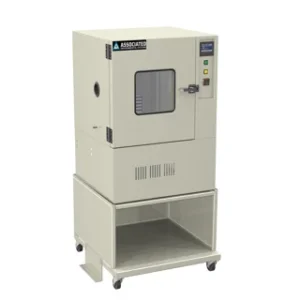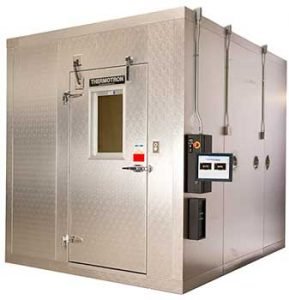
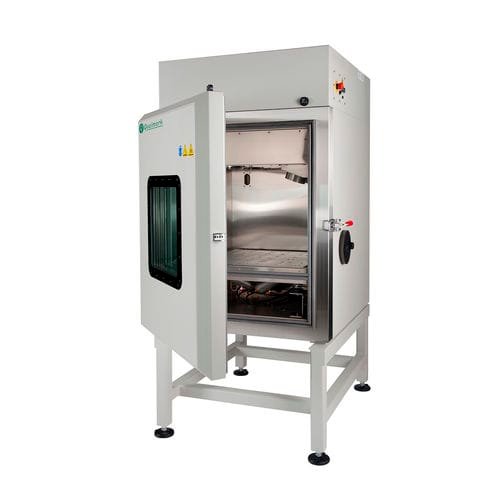

The Qualmark Typhoon 1.5 (OVS-1.5) is a compact environmental test chamber designed for Highly Accelerated Life Testing (HALT) and Highly Accelerated Stress Screening (HASS). It combines rapid thermal cycling with omni-axial six-degree-of-freedom repetitive-shock vibration to accelerate product failure modes and validate design robustness in accelerated timelines.
Technical Specifications
Thermal Performance
• Temperature range: +200°C to −100°C
• Average thermal ramp rate: 70°C/min (single phase), 60°C/min (single phase), 70°C/min (three phase)
• Heating: Open-element NiChrome type
• Cooling: Liquid nitrogen (LN2) injection
Vibration System
• Omni-Axial™ six-degree-of-freedom random broadband excitation: 10 Hz to above 5,000 Hz
• Acceleration range: 5–70 gRMS; special order up to >100 gRMS
• Vibration excitation: Repetitive-shock via four pneumatic, impulse-type, lubricant-free actuators
• Vibration table: 18″ × 18″ (457 mm × 457 mm) with 25 threaded 3/8-16 holes on 4″ centers
• Table capacity: 80 lbs (36 kg) recommended; 160 lbs (72.57 kg) maximum
• Power Spectral Density (PSD) management included with xLF2 Vibration Table
Environmental Chamber
• Work space: 27″w × 27″d × 19.5″h (686 mm × 686 mm × 496 mm)
• Interior construction: 304 stainless steel
• Lighting: Recessed ceiling lights
Control & Software
• Controller: Allen-Bradley PLC
• Interface: Desktop PC with 17″ monitor or flat panel
• Software: Typhoon Manager Software
Electrical
• Single phase: 208 V or 230 V, 50/60 Hz, 70 A service rating
• Three phase: 380 V, 400 V, 440 V, or 480 V, 50/60 Hz, 25 A service rating
– Key Features
• Utility cost savings: 30–60% reduction versus comparable systems
• Compact footprint suitable for space-constrained laboratories
• One accelerometer for table control plus three additional input channels
• Two 72″ thermocouples included (one for product temperature measurement)
• Two-year warranty; operations and maintenance documentation provided
– Typical Applications
• Accelerated life testing of electronics, consumer products, and assemblies
• Design weaknesses identification through combined thermal and vibration stress
• Failure mode and effects analysis (FMEA) validation
• High-reliability product screening prior to production release
– Compatibility & Integration
Available in single-phase (Part 971-4019) and three-phase (Part 971-4021) configurations to match facility power distribution infrastructure.