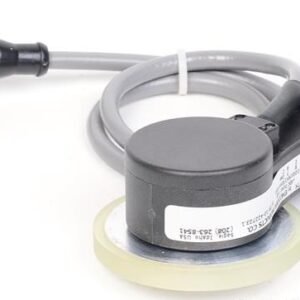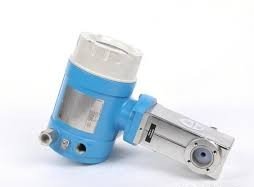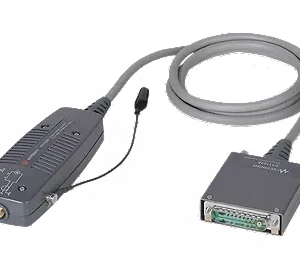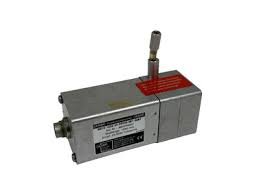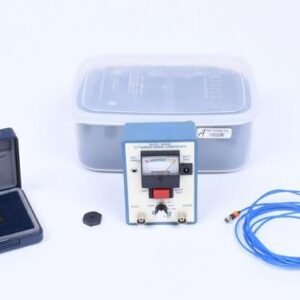

The Ransco-Statham 925-1-4-D-0 is a pressure transducer engineered for vacuum measurement across wide operating ranges. This sensor employs thermal conductivity measurement principles to deliver accurate readings from ultra-high vacuum to atmospheric pressure. The unit integrates digital communication (RS232/RS485) alongside analog outputs and mechanical relay control, enabling both real-time monitoring and process automation. Its low power consumption and compact architecture suit integration into laboratory and industrial vacuum systems where reliability and precision are critical.
Technical Specifications
Measurement Principle: Thermal conductivity vacuum transducer
Pressure Range: 1×10⁻⁵ Torr to Atmosphere
Accuracy:
• 5×10⁻⁴ to 1×10⁻³ Torr: ±10% of reading
• 1×10⁻³ to 100 Torr: ±5% of reading
• 100 Torr to Atmosphere: ±25% of reading
Repeatability: ±2% of reading (1×10⁻³ to 100 Torr range)
Output Signals:
• 1 V/decade analog output (1–10 VDC) with 16-bit resolution
• Secondary analog output with 12-bit resolution
• Three mechanical relays for process control
• RS232 or RS485 digital interface
Setpoint Relay Coverage: 1×10⁻⁴ Torr to Atmosphere
Power Supply: 9–30 VDC
Power Consumption: < 1.2 W
Internal Protection: Thermal recoverable fuse, 200 mA
– Key Features
• Wide vacuum measurement span from 1×10⁻⁵ Torr to atmospheric conditions
• Dual analog outputs enable flexible system integration and redundancy
• Three relay outputs support pump interlocking and valve actuation
• Orientation-independent mounting without accuracy degradation
• Digital communication protocols for remote monitoring and configuration
• Low power draw suitable for battery-backed or distributed monitoring architectures
– Environmental Requirements
Designed for clean environments. Do not operate in corrosive gas atmospheres (fluorine-based etch processes) or flammable/explosive environments. Mount away from pumps and vibration sources to ensure representative measurement.
– Typical Applications
• Vacuum system process control and interlocking
• Research laboratory vacuum monitoring
• Industrial vacuum furnace and chamber management
• Semiconductor processing equipment (non-corrosive environments)
• Cryogenic system pressure supervision