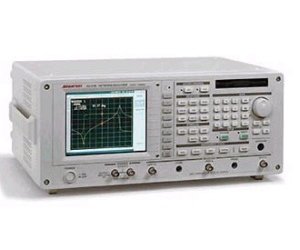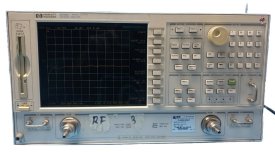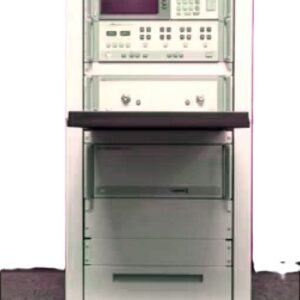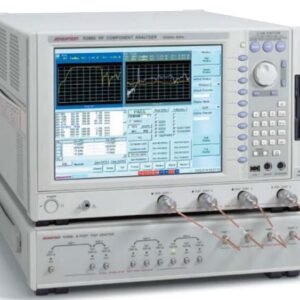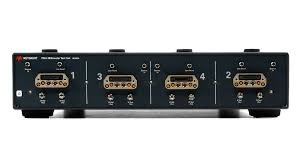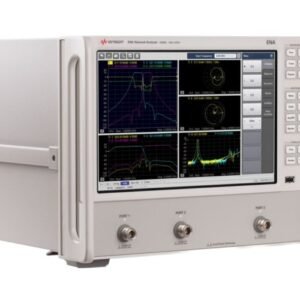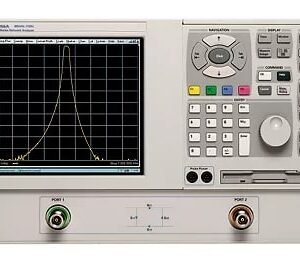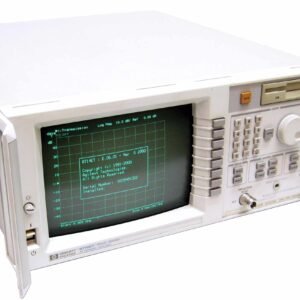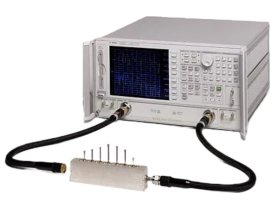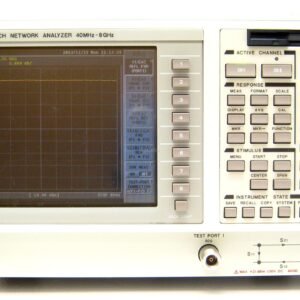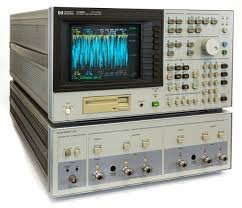

The Rohde & Schwarz ZVM is a benchtop vector network analyzer engineered for S-parameter measurements and RF/microwave component characterization across 10 MHz to 20 GHz. It delivers dynamic range exceeding 115 dB from 0.5 to 8 GHz and measurement speeds under 0.5 ms/point, making it suited for R&D, manufacturing, and quality assurance in telecommunications, aerospace, defense, and semiconductor sectors.
Technical Specifications
Frequency Performance
• Frequency range: 10 MHz to 20 GHz
• Frequency resolution: 100 µHz
• Measurement bandwidths: 1 Hz to 10 kHz (9 steps) and 26 kHz
Measurement Capability
• Output power: +5 dBm/+2 dBm to −85 dBm or 0 dBm/−5 dBm to −85 dBm
• Power uncertainty: 115 dB (0.5–8 GHz); >110 dB (8–16 GHz); >100 dB (16–20 GHz)
• Inherent noise: <−110 dBm (10 Hz bandwidth)
• Measurement time: <0.5 ms/point (normalized)
• Two-port calibrated sweep (401 points, 10 kHz IF): 210 ms bidirectional
Calibration & Impedance
• Calibration methods: TOM, TRM, TNA, TOM-X, AutoKal, TRL, TOSM, normalization
• Impedance: 50 Ω
– Key Features
• Integrated generator with two reference and two receiver channels
• Bidirectional test set for efficient two-port measurements
• S-parameter and group delay measurements
• Nonlinear device characterization: intercept points, compression points, harmonics
• Frequency-converting DUT analysis: conversion loss, intermodulation, spurious response
• Amplifier gain, compression, and harmonic display versus power
• Front-end measurements: simultaneous sideband display, LO crosstalk, RF input matching
• Time domain transformation capability
– Typical Applications
• Component and subsystem characterization in RF and microwave design
• Manufacturing test and quality assurance
• Nonlinear behavior analysis of active devices
• Amplifier performance validation and optimization
– Compatibility & Integration
• Test ports: PC 3.5 male and 2.92 mm male connectors
• Internal PC: Windows NT
• Connectivity: Ethernet RJ-45 (ZVM-B16) or IEC/IEEE interface (ZVM-B17)
• Data transfer time: <15 ms for 200 points via IEC/IEEE bus