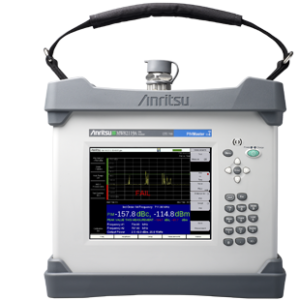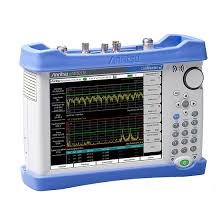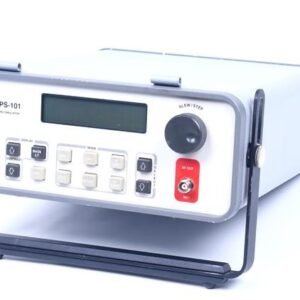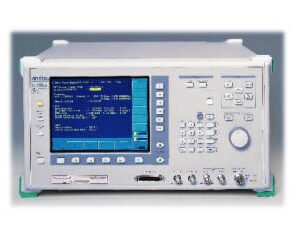
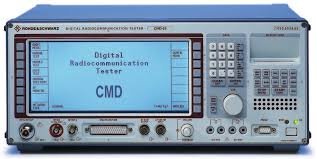

The Rohde & Schwarz CMD80 is a digital radiocommunication tester that emulates a base station for comprehensive testing of mobile units across CDMA, TDMA, and analog standards. It verifies RF parameters under realistic network conditions and supports multiple frequency bands from 824 MHz to 1900 MHz, making it suitable for production, development, and service applications.
Technical Specifications
The CMD80 operates across cellular, PCS, GSM, and DCS frequency bands. The signal generator covers 869 MHz to 894 MHz with output levels ranging from -20 dBm to -124 dBm (RF in/out) or -17 dBm to -131 dBm (alternative specification), plus +3 dBm to -112 dBm on RF OUT2. The signal analyzer operates from 824 MHz to 849 MHz with power measurement capability from +41 dBm to -28 dBm (RF in/out) and 0 dBm to -69 dBm (RF in 2), delivering 50 dB dynamic range below reference level.
Supported standards include CDMA (IS-95, J-STD-008, UB-IS95), Digital AMPS (TDMA IS-136, IS-54), Analog AMPS, N-AMPS, TACS, and GSM variants at 1900 MHz, DCS 1800, and DCS 1900. Modulation support includes QPSK and π/4 DQPSK generation, with O-QPSK demodulation capability.
– Key Features
• Tri-mode/dual-band base station emulation with configurable CDMA, IS-136, AMPS, and TACS operation
• White Gaussian noise injection to simulate CDMA traffic channels (Option B81)
• Frame error, waveform quality, error vector magnitude, and phase error measurements
• Magnitude error, carrier feedthrough, and frequency accuracy analysis
• Adjacent-channel power measurements (peak and statistical modes)
• Carrier switching time and power measurements
• Voice and data loop-back modes for signaling and RF verification
• IEEE 488/IEC 625 (GPIB) and RS-232 remote control
• Autotest modes for complete mobile unit testing
• LCD display with softkey interface
• Operating temperature range: 0 °C to 45 °C; storage: -40 °C to +60 °C
– Typical Applications
Production line validation, development and protocol testing, mobile device service and repair, base station simulation, and RF performance verification under controlled conditions.
– Compatibility & Integration
Remote operation via GPIB and RS-232 interfaces enables integration into automated test systems. Optional OCXO reference oscillator (B1) available for enhanced frequency stability.