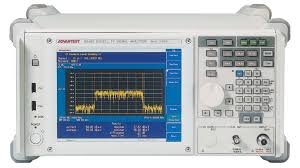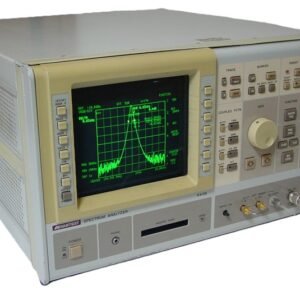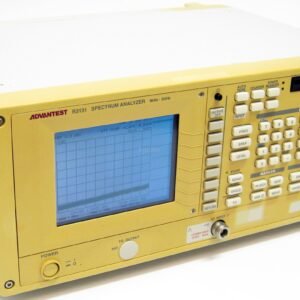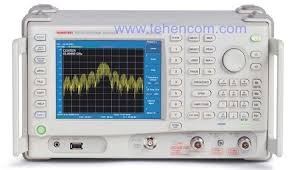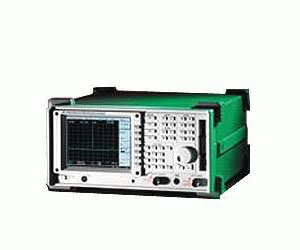
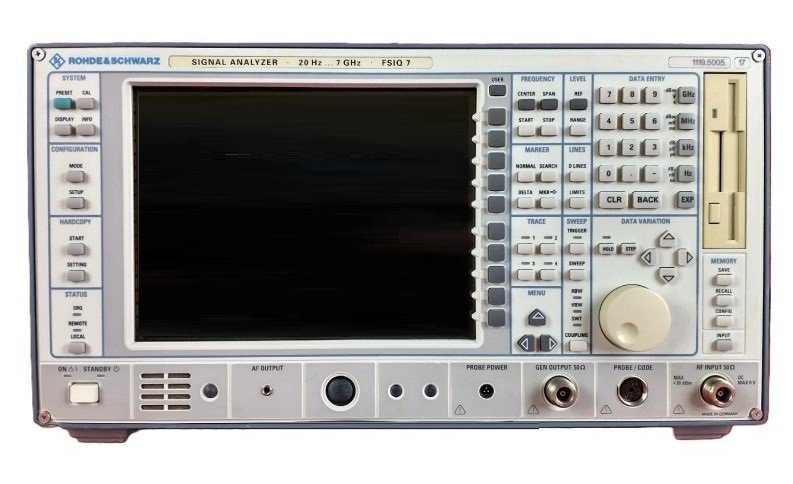

The Rohde & Schwarz FSIQ7 is a high-performance spectrum analyzer spanning 20 Hz to 7 GHz, engineered for RF measurements in development, production, and service environments. It combines wideband spectrum analysis with integrated vector signal analysis, delivering exceptional dynamic range and sensitivity across modern communication standards. The instrument achieves a displayed average noise floor of -159 dBm typical at 1 Hz bandwidth and maintains intermodulation-free dynamic range exceeding 110 dB. Its third-order intercept of +20 dBm and phase noise of -150 dBc (1/Hz) at 5 MHz offset enable precise characterization of low-level and distorted signals.
Technical Specifications
Frequency Domain Analysis
• Frequency range: 20 Hz to 7 GHz
• Resolution bandwidth: 1 Hz to 10 MHz (1/2/3/5 steps); FFT filter option 1 Hz to 1 kHz
• 5-pole resolution filters with high selectivity
• Intermodulation-free dynamic range: >110 dB
• Third-order intercept: +20 dBm
• Displayed average noise floor: -159 dBm typical (1 Hz bandwidth)
• Noise figure: 15 dB typical
• Phase noise: -150 dBc (1/Hz) at 5 MHz offset
• Harmonics suppression: <-90 dBc at 1 GHz
• Spurious emissions: <-90 dBc at 1 GHz
• ACPR for WCDMA: 75 dB in 4.096 MHz integration bandwidth; 82 dB alternate channel
Vector Signal Analysis
• Modulation types: BPSK, QPSK, (G)MSK, 16QAM, AM, FM, PM
• Symbol rate: Up to 6.4 Msymbol/s
• 13 digital demodulators available
• EVM analysis with phase, frequency error, waveform factor, and I/Q offset measurement
• Constellation diagrams, vector displays, and spreadsheet numeric evaluation
• Application firmware for GSM, EDGE, CDMA One, and WCDMA standards
Time Domain Analysis
• Zero span sweep time: 1 µs; 100 ns/div for burst edge resolution
• Full span sweep time: 5 ms (FSIQ7)
– Key Features
• Single instrument combines spectrum and modulation analysis
• Noise floor of -174 dBm/Hz at room temperature enables weak signal detection
• Fast measurement capability with 5 ms full-span acquisition
• Adjustable cosine/root-cosine filters (0.01 step width)
• Multi-standard demodulation for mobile radio applications
– Typical Applications
• Cellular base station and mobile device characterization (GSM, EDGE, WCDMA)
• Adjacent channel power ratio testing
• Phase noise and spurious emissions measurement
• Modulation quality assessment and EVM analysis
• Time-domain burst signal analysis
– Compatibility & Integration
Application firmware options K10, K11, K20, K21, K30, K31, K71, K72, and K73 support GSM, EDGE, and WCDMA deployments across 850 MHz, 900 MHz, and standard frequency bands for mobile and base station configurations.