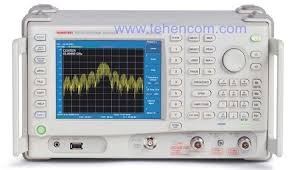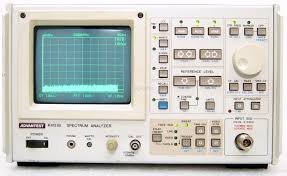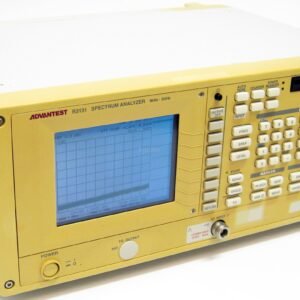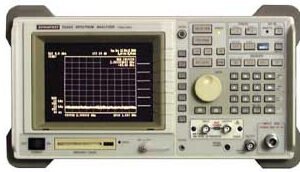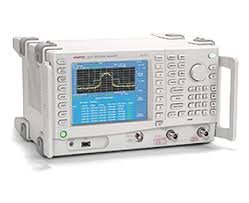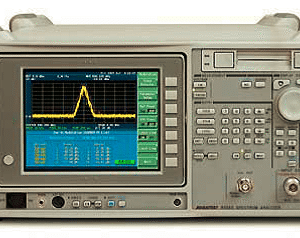
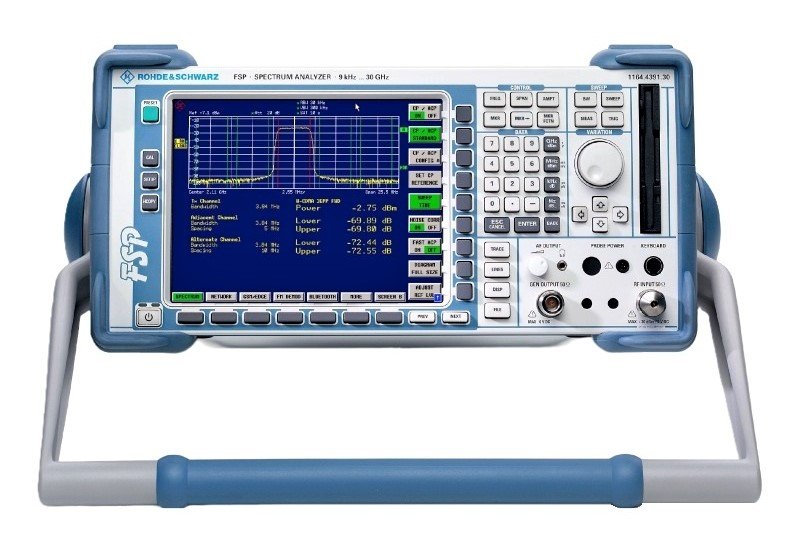

The Rohde & Schwarz FSP40 is a high-performance spectrum analyzer covering 9 kHz to 40 GHz, engineered for signal analysis, component testing, and EMC investigations. Built on super-heterodyne receiver architecture, it delivers measurement uncertainty of 0.5 dB with linearity error below 0.2 dB down to -70 dB. The instrument combines fast acquisition—minimum sweep times of 2.5 ms in frequency domain and 1 µs in time domain—with versatile detection and filtering for demanding RF characterization.
Technical Specifications
Frequency Coverage: 9 kHz to 3 GHz, 7 GHz, 13 GHz, 30 GHz, or 40 GHz
Resolution Bandwidth: 1 Hz to 10 MHz; digital filters 10 Hz to 100 kHz (1, 3, 10 steps); analog filters 300 kHz to 10 MHz (1, 3, 10 steps); 39 channel filters 100 Hz to 5 MHz; FFT filters 1 Hz to 30 kHz; RRC filters (IS-136, TETRA, WCDMA); EMI bandwidth standard
Noise Performance: Displayed Average Noise Level typically -155 dBm (1 Hz); Phase noise typically -113 dBc at 10 kHz offset, -125 dBc at 1 MHz offset, -145 dBc at 10 MHz offset (CF 500 MHz)
Measurement Performance: Dynamic range 100 dB (RMS detector); up to 100 measurements/s in manual operation; 80 measurements/s via GPIB (zero span); 70 remote measurements/s via GPIB
IF Section: 12-bit digitizer
– Key Features
• Multiple detector types: Max, Min-Peak, Auto-Peak, Sample, RMS, Average, Quasi-Peak
• Modulation analysis: FM/PM/AM demodulation with statistical functions (crest factor, CCDF, APD)
• Power measurements: Third Order Intercept (TOI), Adjacent Channel Power (ACP), Multi-Carrier ACP, Occupied Bandwidth, harmonic distortion
• Noise characterization: Phase noise and noise figure measurements
• Standards support: Bluetooth, GSM/EDGE, 3GPP WCDMA, HSDPA, TD-SCDMA, CDMA2000, 1xEV-DV, 1xEV-DO, WLAN 802.11a
– Typical Applications
Spurious emissions testing per GSM specifications; W-CDMA/3GPP adjacent-channel power validation; harmonic and intermodulation distortion analysis; EMC pre-compliance investigation; phase noise characterization across wide frequency bands.
– Compatibility & Integration
GPIB interface supports high-speed remote control and automated measurement sequences. Trace transfer capability (501 binary data points) enables rapid post-processing integration.