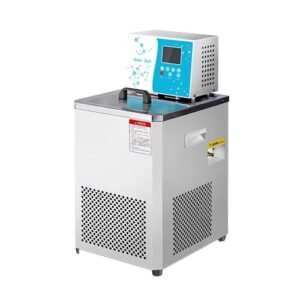

The Sigma Systems C4 is a programmable temperature controller engineered for precise thermal management in environmental test chambers and thermal platforms. It delivers ±0.1°C control accuracy through dual Platinum 500 ohm RTD probe support with intelligent averaging and selective control modes. The C4 operates via local front-panel control, 100-step multi-program sequencing, or remote command, accommodating demanding thermal cycling and characterization workflows.
Technical Specifications
Temperature Control
• Control accuracy: ±0.1°C
• Dual Platinum 500 ohm RTD probe inputs with probe averaging
• Selectable control probe configuration (single or both probes)
• Temperature display: digital readout
• Operating scales: Celsius or Fahrenheit
Programming & Operation
• 100 Temperature/Duration program steps
• Multi-program storage and recall capability
• Front-panel program entry and execution
• Three operation modes: Local, Program, Remote
• “Touch ‘n Go” rapid thermal cycling feature
• “T-Drive” thermal overdrive capability
Control & Tuning
• PID control with real-time constant adjustment via remote interface
• Factory-optimized operating range per configured device
Firmware
• Upgradeable via RS-232 port
• New processor and firmware architecture (distinct from CC-3 models)
– Key Features
• Two controlled device ports for on/off switching of refrigeration compressor and external loads
• TTL-level control ports with optional solid-state relay upgrade for line-voltage operation
• 3-pin “pigtail” connector for refrigeration control via solid-state relay (standard)
• Remote control via EIA-232 or IEEE-488 GPIB interface
• IEEE-488 GPIB implementation: TALKER/LISTENER with serial poll capability
• Firmware uploads supported through serial port
– Physical & Electrical
• Weight: approximately 24 lbs
• Power requirements: 208 V, 50–60 Hz, 30 A (configuration-dependent)
• Front-panel interface for local operation
– Typical Applications
Environmental test chambers, thermal platforms, thermal cycling validation, device characterization under temperature stress, and multi-step thermal profiling.