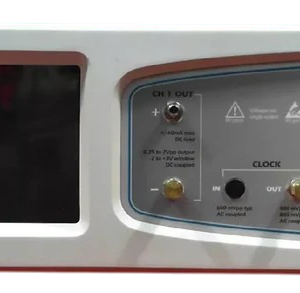
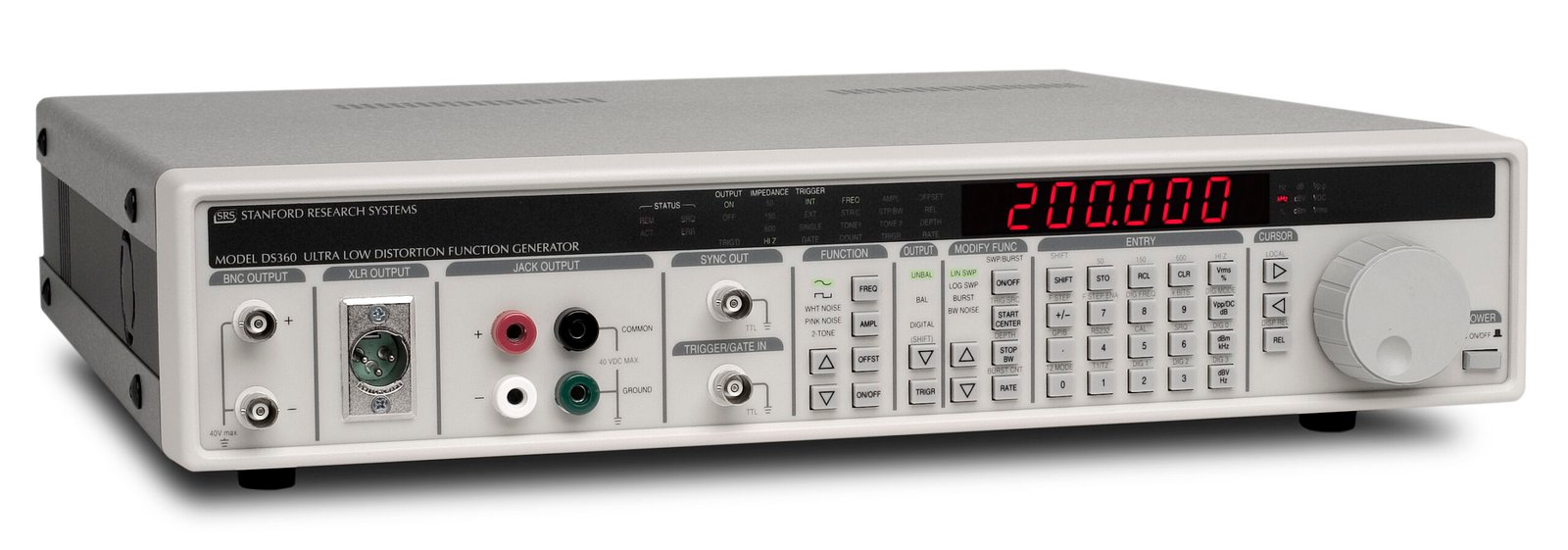

The Stanford Research Systems DS360 is an ultra-low distortion function generator engineered for precision signal generation in demanding measurement and audio applications. It combines Direct Digital Synthesis with analog-grade performance to deliver THD below 0.001%, frequency accuracy of 0.0025%, and exceptional waveform purity across a 1 mHz to 200 kHz range.
Technical Specifications
Frequency Performance
• Frequency range: 1 mHz to 200 kHz
• Frequency resolution: 6-digit
• Frequency accuracy: 0.0025%
• Frequency stability: 25 ppm
Distortion & Signal Quality
• THD at 1 Vrms unbalanced / 2 Vrms balanced:
– Below 5 kHz: −110 dB typical, −106 dB maximum
– 5 to 20 kHz: −104 dB typical, −100 dB maximum
– 20 to 40 kHz: −100 dB typical, −96 dB maximum
– 40 to 100 kHz: −90 dB typical, −85 dB maximum
– 100 to 200 kHz: −76 dB typical, −68 dB maximum
• THD at 10 Vrms unbalanced / 20 Vrms balanced:
– Below 5 kHz: −109 dB typical, −105 dB maximum
– 5 to 20 kHz: −103 dB typical, −99 dB maximum
– 20 to 40 kHz: −98 dB typical, −93 dB maximum
– 40 to 100 kHz: −88 dB typical
Amplitude Specifications
• Output range: 20 µVpp to 40 Vpp
• Unbalanced output: 0 to ±7.4 VDC (50 Ω load), 0 to ±10.0 VDC (600 Ω load), 0 to ±20.0 VDC (Hi-Z load)
– Key Features
• 20-bit D/A converter with DSP and DDS architecture
• Waveforms: Sine, square, two-tone (independent frequency/amplitude control), white noise, pink noise, band-limited white noise
• Two-tone formats: SMPTE, DIM, CCIF for intermodulation distortion testing
• Frequency sweep and tone burst capabilities
• Low output noise with optimized shielding and board layout
• Requires 1 hour warm-up for performance verification
– Typical Applications
• Audio system characterization and distortion analysis
• Precision impedance and network measurements
• Sensitive electronics testing
• Intermodulation distortion (IMD) evaluation
• Frequency sweep and parametric testing
– Compatibility & Integration
• RS-232 interface for device control and automation
• GPIB interface for instrumentation system integration
• User-accessible front panel controls