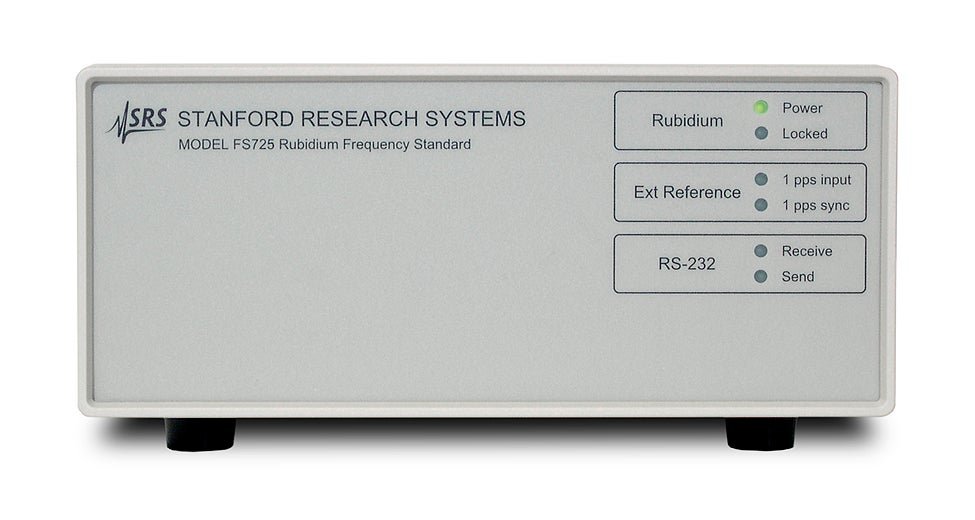

The Stanford Research Systems FS725 is a benchtop rubidium frequency standard delivering ultra-stable 10 MHz reference signals for precision metrology, calibration, and research applications. Built around the SRS PRS10 rubidium oscillator and housed in a compact half-width 2U chassis, the FS725 combines exceptional long-term aging performance with demonstrated reliability exceeding 200,000 hours MTBF. The instrument outputs two 10 MHz sine waves, one 5 MHz sine wave, and one 1 pps signal, each with low phase noise and minimal jitter. Optional internal distribution modules expand output count to 22 total channels while maintaining specification compliance across all ports.
Technical Specifications
Frequency Outputs
• Two 10 MHz sine wave outputs
• One 5 MHz sine wave output
• One pulse-per-second (1 pps) output
Output Amplitude & Power
• 10 MHz / 5 MHz: 0.5 V rms ±10% into 50 Ω (1.41 V pp, +7 dBm)
• 1 pps pulse: 2.5 V into 50 Ω; 5 V into high-impedance loads
• 1 pps pulse width: 10 µs
Stability & Aging
• One-second Allan variance: <2 × 10⁻¹¹
• 20-year aging rate: <5 × 10⁻⁹ (−130 dBc/Hz at 10 Hz offset (SSB)
• >−140 dBc/Hz at other offsets
1 pps Synchronization
• External 1 pps locking to GPS or similar references
• Lock time constant: 8 minutes to 18 hours (computer-adjustable)
• Output jitter: 200,000 hour MTBF
• Sub-nanosecond 1 pps jitter for timing applications
• Stratum 1 performance via external GPS 1 pps locking
• Low-noise AC power supply integrated
• Computer control and remote monitoring via RS-232
• Modular output expansion without performance degradation
– Typical Applications
• Primary frequency reference in calibration laboratories
• Timing reference for test equipment synchronization
• GPS disciplined clock systems and time-keeping networks
• Precision measurement and metrology setups
• Research environments requiring long-term frequency stability
– Compatibility & Integration
The FS725 operates as a standalone instrument or integrates into larger timing systems through its external 1 pps locking input. RS-232 control enables automation and remote monitoring in networked lab environments. Optional distribution modules allow a single FS725 to serve multiple test instruments and data acquisition systems from one reference source.