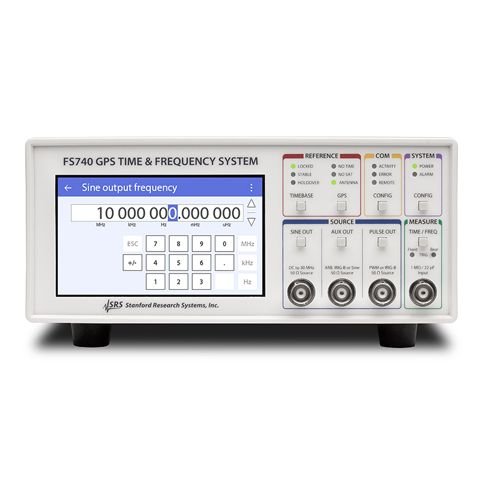

The Stanford Research Systems FS740 is a GPS/GNSS-disciplined time and frequency reference system delivering 10 MHz outputs with long-term stability better than 1 × 10⁻¹³. It integrates a multi-constellation GNSS receiver (GPS, GLONASS, BEIDOU, GALILEO) to discipline its internal oscillator, providing phase-coherent timing and frequency synthesis across a range of output formats.
Technical Specifications
Disciplined Oscillator & Stability
• GPS/GNSS-disciplined 10 MHz reference
• Long-term frequency stability: Better than 1 × 10⁻¹³
• Standard timebase short-term stability: 1 × 10⁻⁹; phase noise (SSB) <−105 dBc/Hz at 10 Hz offset
• Optional OCXO timebase: Short-term stability 1 × 10⁻¹¹; phase noise <−130 dBc/Hz at 10 Hz offset; holdover <40 ps/24 hr
• Optional Rubidium timebase: Short-term stability 1 × 10⁻¹²; phase noise 1 μs/day without GNSS
Frequency Measurement & Synthesis
• 12 digit/s frequency counter with 1 × 10⁻¹¹ precision (1 s), 1 × 10⁻¹² (10 s), 1 × 10⁻¹³ (100 s)
• DDS synthesized outputs: 1 μHz to 30.1 MHz (1 μHz resolution) or fixed 100 MHz
• Low-jitter pulse outputs: 1 mHz to 25 MHz with <50 ps rms jitter; pulse width 5 ns to period−5 ns at 10 ps resolution
• IRIG-B timecode output
• Output impedance: 50 Ω; harmonics −40 dBc; spurious −70 dB
• Optional rear-panel boards: Up to 15 additional 10 MHz, sine, or pulse output copies
Time Tagging
• Event time tagging with 1 ps resolution and ~10 ns rms error relative to UTC or GPS time
Interfaces & Power
• Ethernet (10/100 Base-T, TCP/IP, DHCP) and RS-232
• Front-panel graphical display; rear connectors for antenna, measurement input, source outputs
• AC input: 90–264 VAC, 47–63 Hz with PFC; 90 W consumption
– Key Features
• Multi-constellation GNSS receiver with automatic constellation selection
• Selectable timebase options for precision-to-stability tradeoffs
• Arbitrary waveform synthesis (sine, ramp, triangle) via AUX output
• Microsecond-level holdover performance with optional Rubidium upgrade
• Picosecond-resolution event time-tagging for synchronization applications
– Typical Applications
• Frequency metrology and calibration laboratories
• Network synchronization and PTP grandmaster clocking
• Cellular base station timing (4G/5G)
• Broadcast and satellite communication standards
• Physics experiments requiring phase coherence
– Compatibility & Integration
The FS740 communicates via standard Ethernet (TCP/IP) and RS-232 for remote operation. Its configurable outputs accommodate both analog (sine) and digital (pulse, IRIG-B) timing signals, enabling integration with legacy and modern test systems. The system accepts external GNSS antennas and supports event input for precise time-tagging of external signals.