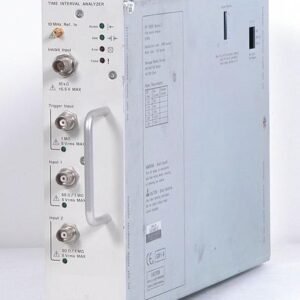


The Stanford Research Systems FS752 is a GPS/GNSS disciplined time and frequency reference engineered for precision synchronization in metrology labs, observatories, and critical infrastructure requiring sub-nanosecond timing accuracy. It tracks GPS, GLONASS, BEIDOU, and GALILEO constellations simultaneously, delivering stable 10 MHz and 1 PPS outputs locked to atomic clock accuracy. The instrument employs a double-oven controlled 3rd overtone SC-cut crystal oscillator with <2×10⁻⁹ temperature stability and phase noise below –125 dBc/Hz at 10 Hz offset. Satellite acquisition completes within one minute; almanac lock takes approximately 15 minutes under continuous power. If GNSS signal is lost, the holdover timebase maintains lock with aging less than ±0.05 ppm/year.
Technical Specifications
Oscillator:
• Double-oven controlled, 3rd OT SC-cut crystal
• Temperature stability: <2×10⁻⁹ (20–30 °C)
• Aging: <0.2 ppm/year (undisciplined to GPS)
• Phase noise: <–125 dBc/Hz at 10 Hz offset
GNSS Receiver:
• Constellations: GPS, GLONASS, BEIDOU, GALILEO
• Satellite acquisition: <1 minute typical
• Almanac acquisition: ~15 minutes (continuous power)
• Holdover aging: <±0.05 ppm/year
10 MHz Outputs:
• Standard: Five buffered outputs (optional: up to 8 additional)
• Amplitude: 1 Vrms into 50 Ω
• Harmonics: <–40 dBc
• Spurious: <–90 dBc (100 kHz bandwidth)
• Output coupling: DC, 50 Ω ±2 %
• Reverse protection: ±5 VDC
1 PPS Outputs:
• Standard: Two buffered outputs (optional: up to 8 additional)
• Width: 10 µs
• Phase accuracy: <2 ns (to internal reference)
• Jitter: <50 ps rms
• Level: +5 V CMOS logic
• Transition time: <2 ns
• Source impedance: 50 Ω
• Reverse protection: ±5 VDC
Stability:
• TDEV between instruments: A few nanoseconds
– Key Features
• Multi-constellation GNSS tracking eliminates single-system dependency
• Automatic position survey and fixing
• Configurable alarm relay for GNSS lock, timebase health, or holdover monitoring
• USB interface for full programmability and real-time status queries
• Holdover operation maintains frequency lock when GNSS signal drops
– Typical Applications
Precision frequency distribution, laboratory timing synchronization, network timing infrastructure, frequency metrology, and applications requiring <2 ns phase accuracy.
– Compatibility & Integration
USB control port supports command-driven operation. Standard 90–264 VAC input, 47–63 Hz. Power consumption <80 VA. No power switch; instrument activates on line cord insertion.