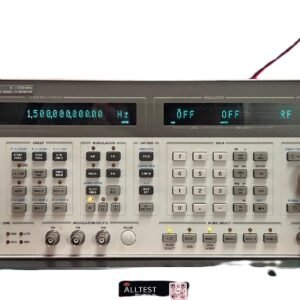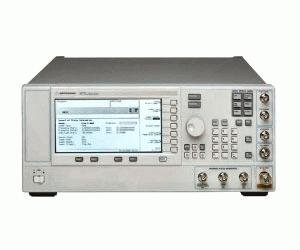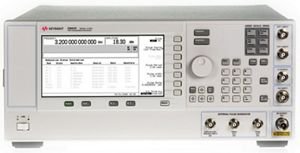
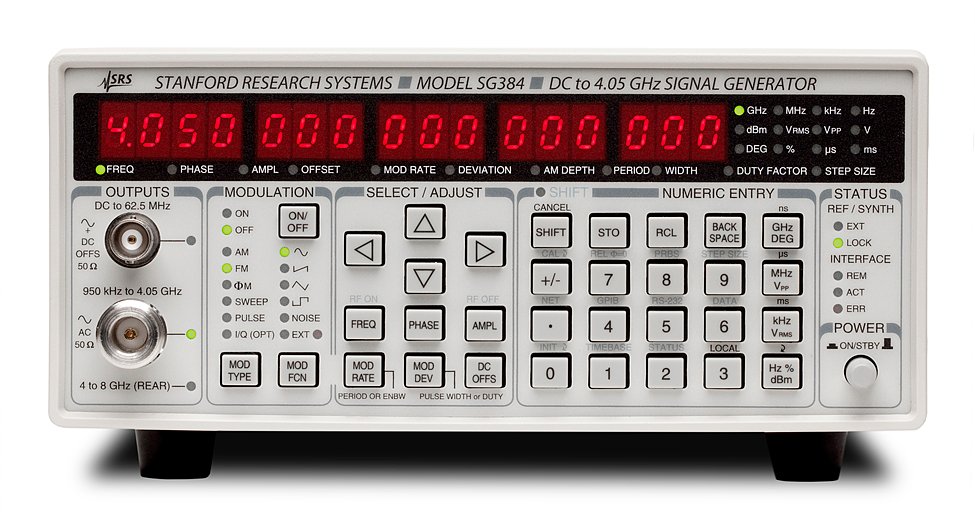

The Stanford Research Systems SG384 is a 4 GHz analog signal generator built on Rational Approximation Frequency Synthesis architecture. It delivers 1 µHz frequency resolution, sub-8 ms switching speed, and exceptional phase noise performance of -116 dBc/Hz at 20 kHz offset. The instrument supports AM, FM, phase modulation, pulse modulation, and continuous sweeps with selectable internal waveforms (sine, ramp, saw, square, pulse, noise) or external modulation sources. RF output ranges from +13 dBm to -110 dBm with ±5% amplitude accuracy. Optional frequency doubler (Opt. 02) extends coverage to 8.10 GHz, while optional I/Q modulation (Opt. 03) enables complex signal generation above 400 MHz. A front-panel BNC output accommodates baseband and low-frequency signals to 62.5 MHz. Suited for research, development, and production RF test environments.
Technical Specifications
• Frequency Range: DC to 4.05 GHz (standard); up to 8.10 GHz with optional doubler
• Frequency Resolution: 1 µHz
• Frequency Switching: <8 ms to within 1 ppm
• Frequency Stability: 1 × 10⁻¹¹ (1 second Allan variance)
• RF Output Power: +13 dBm to -110 dBm
• Amplitude Resolution: 0.1%
• Amplitude Accuracy: ±5%
• Phase Noise (SSB): -116 dBc/Hz at 20 kHz offset (1 GHz); -80 dBc/Hz at 10 Hz offset
• Harmonics: <-25 dBc at +7 dBm output
• Spurious: 40 dBc carrier suppression
• BNC front-panel output: DC to 62.5 MHz, 1 mV to 1 Vrms into 50 Ω
– Typical Applications
• Component and subsystem RF testing
• Phase noise characterization
• Modulation development and validation
• Frequency-agile signal generation
– Compatibility & Integration
External modulation accepts ±1 V input signals. I/Q option supports 50 Ω impedance inputs with ±0.5 V offsets. Standard N-type RF connector.