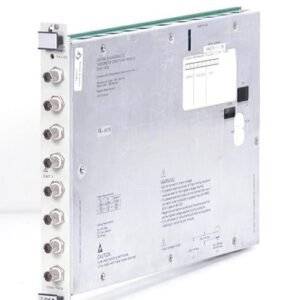
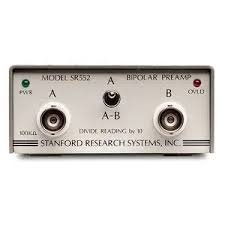

The Stanford Research SR550 is a low-noise FET input preamplifier that amplifies weak signals at the source before cable noise degrades measurement fidelity. By providing gain before signal transmission, it dramatically improves lock-in amplifier sensitivity and reduces measurement times in noise-limited experiments. The preamplifier operates in single-ended or differential mode and integrates directly with SRS lock-in amplifiers via a 9-pin connector, with automatic gain selection on compatible models. Input noise as low as 3.6 nV/√Hz at 1000 Hz enables detection of sub-microvolt signals across the 10 Hz to 100,000 Hz bandwidth.
Technical Specifications
• Input noise: 3.6 nV/√Hz @ 1000 Hz, 4.0 nV/√Hz @ 100 Hz, 13 nV/√Hz @ 10 Hz
• Input impedance: 100 MΩ || 25 pF
• Gain settings: 1, 2, 5, or 10 (automatic on SR510/SR530; fixed at 10 on DSP lock-ins)
• Maximum input: 250 mV RMS; 350 mV peak; 10 V peak AC damage threshold; 100 VDC damage threshold
• Common mode rejection: 90 dB @ 100 Hz (1 V input)
• Maximum output: 7 V peak-to-peak
• Frequency response: 10 Hz to 100,000 Hz
• AC coupled input (1 Hz high-pass characteristic)
• Dimensions: 1.3″ × 3.0″ × 5.1″; Weight: 1 lb
– Key Features
• FET input stage minimizes noise and loading effects
• Single-ended or differential input selection via front panel switch
• Selectable gain optimizes signal-to-noise ratio without saturating lock-in input stages
• AC coupling blocks DC offsets and low-frequency drift
• High common-mode rejection isolates differential signals from ground loop noise
– Power and Integration
The SR550 draws power from the host lock-in amplifier via 9-pin connector cable (+20 VDC @ 100 mA, +5 VDC @ 10 mA, −20 VDC @ 100 mA). Standalone operation requires external biasing supplies. Lock-in detection of preamplifier presence occurs through the DHD command; gain codes 183 in the DGD command enable sensitivities below 100 nV.
– Compatibility & Integration
Works with any SRS lock-in amplifier. On SR510 and SR530 models, gain automatically optimizes based on full-scale sensitivity and dynamic reserve. DSP lock-ins operate at fixed gain 10; divide lock-in readings by 10 to recover signal amplitude.