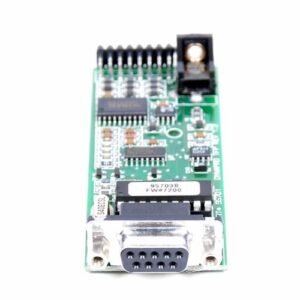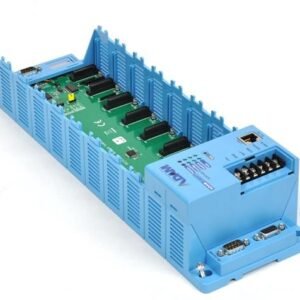

The Stanford Research Systems SIM960 is a single-channel analog PID controller delivering 100 kHz bandwidth for high-speed control applications requiring minimal quantization artifacts and fast response. Built on a hybrid analog signal path with digital parameter control, it achieves 1 µs propagation delay and 8 nV/√Hz input-referred noise above 10 Hz—critical for noise-sensitive feedback loops. All proportional, integral, derivative, and offset parameters are independently tunable and settable to 0.5% precision via serial interface.
Technical Specifications
• Control Architecture: Analog PID + Offset
• Bandwidth: 100 kHz
• Proportional Gain (P): 10⁻¹ to 10³
• Integral Gain (I): 10⁻¹ s⁻¹ to 10⁵ s⁻¹ (time constant range: 10⁻⁵ s to 10 s)
• Derivative Gain (D): 10⁻⁷ s to 1 s
• Offset: ±10 V, 1 mV resolution
• Input Range: ±10 V differential; ±1 V common mode
• User-Settable Gain: Up to 1000×
• Output: ±10 V with user-configurable upper and lower limits
• Propagation Delay: 1 µs typical
• Input Noise Floor: 8 nV/√Hz above 10 Hz
• Setpoint Noise: 20 nV/√Hz above 100 Hz
• Parameter Accuracy: 1%
• Thermal Stability: 200 ppm/°C
• Internal Setpoint Range: ±10 V, 1 mV resolution
– Key Features
• Anti-windup control with fast saturation recovery
• Bumpless manual-to-PID mode transfer
• Smooth setpoint ramping via integrated voltage ramp generator
• Output clamping to prevent system overload
• LED bar display for amplified error signal (P × ε) and output
• Millivolt-resolution numeric readout of setpoint, measurement, error, and output
• Overload indicator LED
– Typical Applications
Laser power stabilization, temperature control loops, optical cavity locking, and any feedback system requiring sub-microsecond response with minimal noise injection.
– Compatibility & Integration
The SIM960 operates as a module within the SIM900 mainframe, drawing power and communicating via 15-pin D-sub connector. Full parameter control and monitoring available through RS-232 and GPIB interfaces provided by the mainframe. Double-width module format; 2.1 lbs.