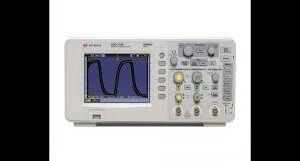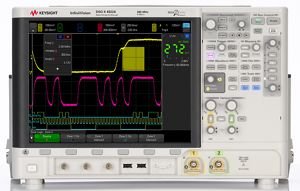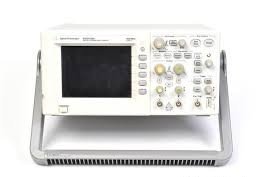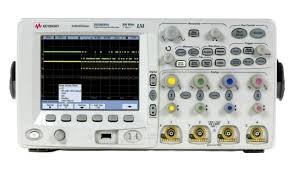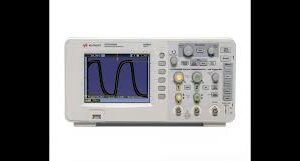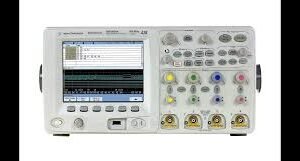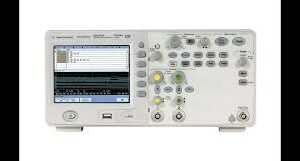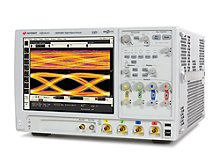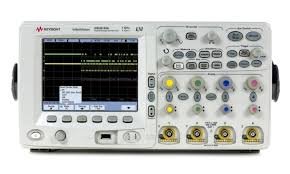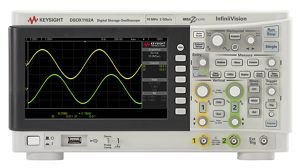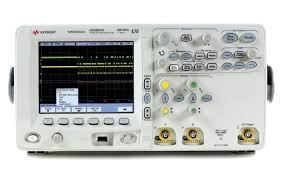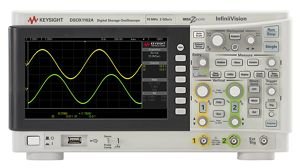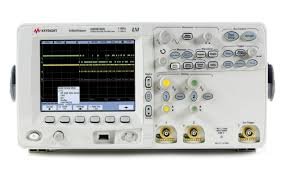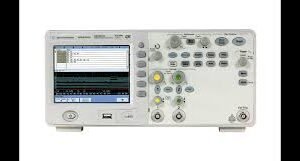

The Tektronix DPO2024B is a 4-channel digital phosphor oscilloscope built for embedded systems design, general electronics testing, and educational environments. It delivers 100 MHz to 300 MHz bandwidth options with 1 GS/s sample rate, 8-bit vertical resolution, and up to 200,000-point record length. The instrument combines advanced triggering, real-time FFT analysis, and 30+ automated measurements to characterize complex signals across DC to high-frequency applications.
Technical Specifications
Acquisition
• Bandwidth: 100 MHz, 150 MHz, 200 MHz, or 300 MHz (selectable)
• Channels: 4
• Sample Rate: 1 GS/s (all channels); 1 GS/s (two channels)
• Record Length: 100,000 points (all channels); 200,000 points (two channels)
• Vertical Resolution: 8 bits
• Bandwidth Limit: 20 MHz, 25 MHz, 30 MHz, 50 MHz, 100 MHz, 150 MHz, 200 MHz, or 300 MHz
• Input Coupling: DC, AC, GND
• Input Impedance: 1 MΩ ±2% || 15 pF ±5 pF, or 50 Ω ±2%
• Probe Range: ±2.5 V to ±10 V
• DC Vertical Accuracy: ±3% of full scale
• Offset: ±2.5 V (at ±10 V range); ±10 V (at ±2.5 V range)
Trigger System
• Types: Edge, Pulse Width, Video, Logic, Pattern, Bus
• Modes: Auto, Normal, Single
• Jitter: <50 ps rms; <10 ps rms (50 Ω input)
• Sensitivity: 10 mV (DC–100 MHz); 50 mV (100 MHz to bandwidth limit)
• Holdoff: 2 ns to 2 s
Display & Capture
• LCD: 10.4 in. diagonal, 800 × 600 pixels, color
• Waveform Capture Rate: 2,941 wfms/s (average mode)
• DPO technology with color-grading intensity display
Measurement & Analysis
• 30+ automated measurements (rise/fall time, frequency, period, RMS, peak-to-peak, duty cycle, pulse width, etc.)
• Waveform math: Add, Subtract, Multiply, Divide, FFT, Averaging, Extrema
• FFT: Real-time with Rectangular, Hanning, Hamming, and Blackman windowing
• Search and Mark for event location within acquisition memory
Interfaces & Power
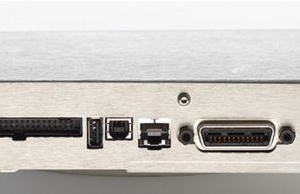
• USB 2.0 Host (front); USB 2.0 Device (rear)
• 10/100 Ethernet (rear)
• Optional GPIB
• Input: 100–240 Vrms, 45–440 Hz
• Consumption: <150 W
• Dimensions: 8.58 in. × 16.93 in. × 5.51 in.
– Key Features
• Four-channel simultaneous acquisition with selectable bandwidth options
• Advanced trigger types including pattern and bus triggering
• Sub-50 ps jitter for precise event timing
• Real-time FFT analysis with multiple window functions
• Dual USB ports and Ethernet for flexible connectivity
• Color LCD phosphor display for signal intensity visualization
– Typical Applications
• Embedded system debugging and signal validation
• General-purpose electronics prototyping and characterization
• Educational laboratory work and signal analysis instruction
• Frequency-domain analysis via real-time FFT
– Compatibility & Integration
USB 2.0 connectivity on front and rear panels supports direct waveform storage and PC-based control. Ethernet enables remote operation and data transfer. Legacy GPIB integration is available through optional modules.