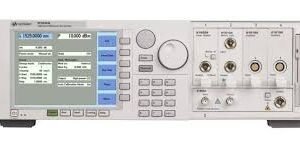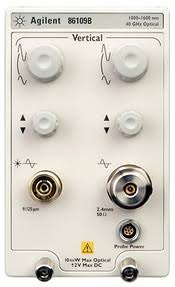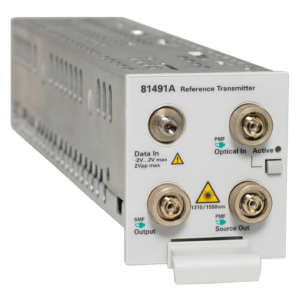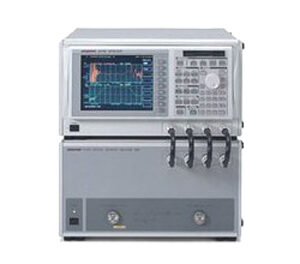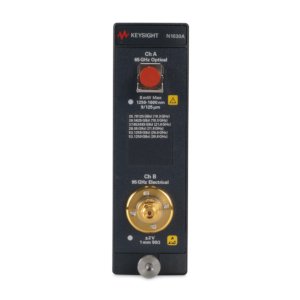

The Tektronix OTS9000 Test System is a PC-based optical transport network (OTN) testing platform engineered for OC-192/STM-64 (10 Gb/s) transmission validation. The system integrates a dedicated CPU with GRIP interface and modular optical network architecture, delivering physical-layer characterization of high-speed optical components and complete OTN systems. It addresses testing requirements across DWDM deployments and modern bandwidth-intensive networks.
Technical Specifications
System Architecture
• CPU with integrated Windows-based operator interface
• Serial, Parallel, USB, Ethernet, and PS/2 (×2) connectivity
• Optional GPIB interface (IEEE 488-1978 compliant) for remote control
• CD-ROM and Floppy Drive
• Reference configuration: Intel Celeron 366 MHz processor, 64 MB RAM, 8 GB HDD, Windows NT v4.0 SP5
• Multi-slot chassis supporting up to 14 optical network interface modules
Optical Performance
• Data rate: OC-192/STM-64 (10 Gb/s)
• Wavelength: 1550 nm
• Output power: 7 dBm
• Optical interface connector: FC/PC (all connections)
• Transmission and reception (Tx/Rx) capable
Supported Modules
• OTS91L1 (OC192/STM64 Tx/Rx Optics)
• OTS91R2 (OC192/STM64 Receiver)
• OTS91T2 (OC192/STM64 Transmitter)
• OTS91C1 (OC192/STM64 Clock and Trigger)
Software & Control
• Windows-based operating system (Windows NT v4.0 SP5, Windows 2000)
• OTS9000 Software v2.1 build 273
• G.709 OTN frame decoding and analysis
• ODUk container mapping and Forward Error Correction (FEC) analysis
– Key Features
• Modular design with multi-slot architecture for scalable test configurations
• DWDM application support
• Full OTN protocol compliance testing
• Dual Tx/Rx capability at OC-192/STM-64 rates
• FC/PC optical connectivity across all channels
– Typical Applications
• Optical transport network validation at 10 Gb/s
• DWDM system characterization
• OTN frame analysis and client signal mapping
• Physical-layer optical component testing
• Network quality and performance verification
– Compatibility & Integration
The system accommodates external peripherals via parallel printer connector and supports optional external monitor and keyboard/mouse operation. GPIB interface enables remote system control and integration into automated test environments. Windows-based software platform provides industry-standard operator workflow.