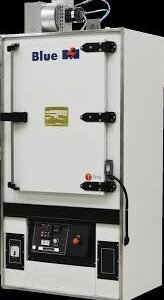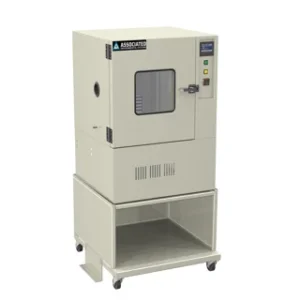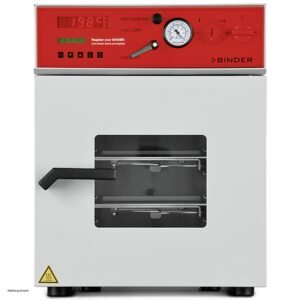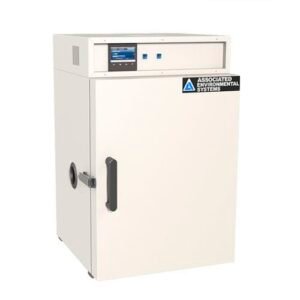

The VWR Scientific 1410 is a compact vacuum oven for laboratory drying, curing, and outgassing under controlled vacuum conditions. Operating from 40°C to 225°C with temperature uniformity of ±2°C at 100°C and ±3°C to ±5°C at 200°C, it maintains vacuum performance to 10 microns or better. The 0.6 cubic feet (17 L) stainless steel chamber reaches 100°C in approximately 30–35 minutes and features a unique contact heating system with cross-flow ventilation for consistent thermal distribution. Dual doors—a solid outer door and inner glass-windowed door—provide visibility and access. The unit incorporates two interior shelves, separate vacuum and gas metering valves with 9.5 mm (3/8″) connections, wrap-around insulation for energy efficiency, and adjustable rubber feet for leveling. Microprocessor-controlled operation (with some units featuring analog setpoint control) enables precise process management. Stainless steel construction inside and out resists corrosion and contamination. At 55 lbs and drawing 550 W at 120V/60Hz/8A, it integrates into standard laboratory power infrastructure.
Technical Specifications
• Chamber volume: 0.6 cu ft (17 L)
• Interior dimensions: 9″ W × 12″ D × 9″ H
• Exterior dimensions: 20.5″ W × 17″ D × 16.3″ H
• Temperature range: 40°C to 225°C
• Temperature uniformity: ±2°C @ 100°C; ±3°C to ±5°C @ 200°C
• Heat-up time: 30–35 minutes to 100°C
• Vacuum performance: 10 microns or better
• Vacuum port: 9.5 mm (3/8″) connection
• Power consumption: 550 W @ 120V/60Hz/8A
• Weight: 55 lbs
– Key Features
• Contact heating system with aluminum shelf heat transfer
• Cross-flow ventilation for uniform thermal distribution
• Dual-door design with glass observation window
• Separate metering valves for vacuum and gas control
• Stainless steel interior and exterior construction
• Wrap-around insulation for thermal efficiency
• Two interior shelves (items must not contact chamber floor)
• Four adjustable rubber feet for leveling
• Microprocessor control (optional analog setpoint controller)
– Typical Applications
• Material drying and moisture removal
• Component curing under vacuum
• Outgassing of polymers and composites
• Thermal processing in research and industrial environments
• Oxidation reduction during heat treatment