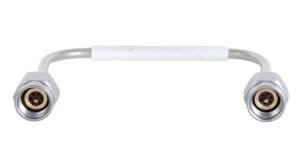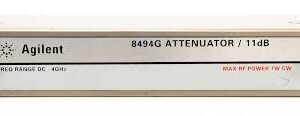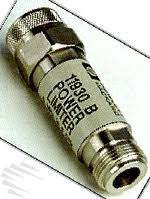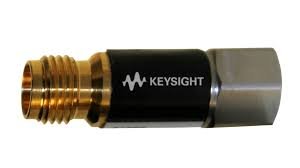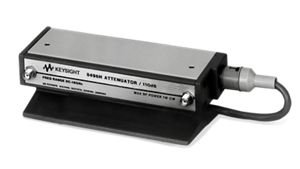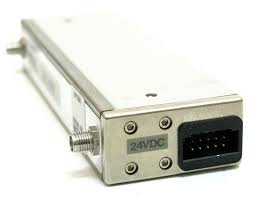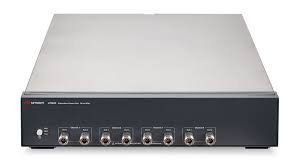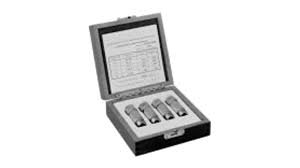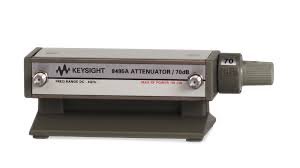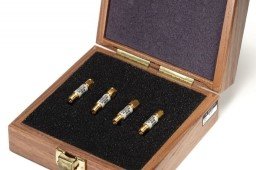

The Weinschel 40 is a fixed coaxial attenuator engineered for RF and microwave signal level reduction in demanding test and measurement environments. Offering attenuation values from 3 dB to 40 dB with accuracy of ±0.75 dB, it delivers stable performance across multiple frequency bands while maintaining exceptional VSWR characteristics. The unit handles 150 W average power at 25°C ambient, with peak capability of 10 kW, making it suitable for high-power applications requiring precise impedance matching and signal conditioning.
Technical Specifications
Electrical Performance
• Nominal impedance: 50 Ohms
• Attenuation range: 3 dB to 40 dB (standard values at 10 dB, 20 dB, 30 dB)
• Attenuation accuracy: ±0.75 dB
• Maximum VSWR: 1.10
• Power coefficient: <0.0001 dB/dB/W (unidirectional)
• Temperature coefficient: <0.0004 dB/dB/°C
• Operating temperature: -55°C to +125°C
Power Handling
• Average power rating: 150 W @ 25°C ambient, derated to 15 W @ 125°C (50 W models available)
• Peak power rating: 10 kW (5 µsec pulse, 0.75% duty cycle)
Frequency Coverage
• Multiple band options: DC to 1.5 GHz, DC to 3.0 GHz, DC to 5.0 GHz, DC to 8.5 GHz, DC to 18.0 GHz
– Key Features
• Four connector options: Type N, 7/16 DIN, SMA, TNC (male and female configurations available)
• Stainless steel connectors with gold-plated beryllium copper or stainless steel contacts
• Black aluminum alloy body with passivated stainless steel hardware
• Low intermodulation option available (add "-LIM" suffix)
• RoHS compliant
• Meets MIL-DTL-3933 environmental specification
• Mating per MIL-PRF-39012/MIL-STD-348A (non-destructive)
Physical Dimensions
• Height: 65.5 mm, Width: 79.2 mm
• Length by connector type: SMA 9.8–10.9 mm, Type N 14.9–22.7 mm
• Weight: ~1.00 kg
– Typical Applications
Power level control in RF test systems, impedance matching networks, measurement calibration, high-power signal conditioning.
– Compatibility & Integration
Standard insertion loss and VSWR calibration provided; calibration test data available at additional cost. Connector flexibility supports integration into diverse test architectures.