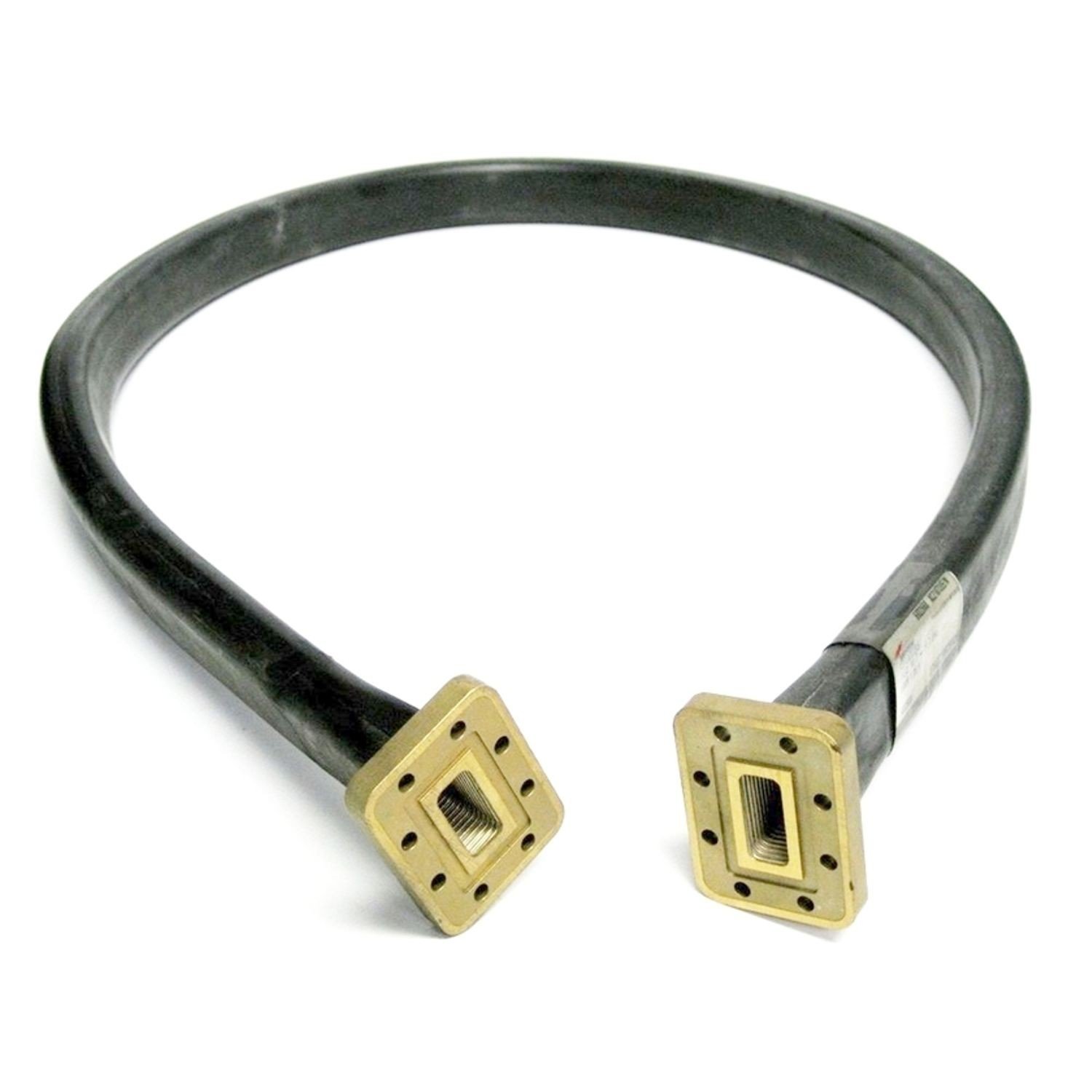

The WR137 flexible waveguide is a rectangular waveguide assembly designed to interconnect RF components across the 5.85 GHz to 8.20 GHz frequency range. With a 30-inch length and internal dimensions of 1.372 × 0.622 inches (34.8488 × 15.7988 mm), this EIA-standard waveguide accommodates applications requiring mechanical flexibility, vibration isolation, or precise alignment. The silver-plated interior and protective outer jacket minimize insertion loss while offering corrosion resistance and durability in field environments.
Technical Specifications
• Waveguide Designation: WR137 (EIA), R70 (IEC), WG14 (British Military)
• Operating Frequency Range: 5.85 GHz to 8.20 GHz
• Frequency Band: C-Band
• TE10 Cutoff Frequency: 4.301 GHz
• TE11 Upper Mode Cutoff: 8.603 GHz
• Internal Dimensions: 1.372 × 0.622 inches (34.8488 × 15.7988 mm)
• Wall Thickness: Approximately 0.064 inches
• VSWR: Typically 1.05:1 to 1.25:1
• Insertion Loss: 0.05 dB/ft to 0.12 dB/ft depending on material and construction
• Average CW Power Handling: 100 W to 5000 W (configuration-dependent)
• Peak Power Handling: 0.50 MW to 500 MW (configuration-dependent)
– Key Features
• Available in aluminum and copper alloy construction with optional silver plating
• Protective neoprene rubber jacket for mechanical support and environmental protection
• E-Plane minimum bend radius: 1.50 inches (without jacket), 2.38 inches (with jacket)
• H-Plane minimum bend radius: 2.07 inches (without jacket), 3.38 inches (with jacket)
• Chemical-resistant epoxy and urethane finish options
• Chromate conversion or silver-plated internal surfaces
– Applications
• Radar systems and microwave test equipment
• Satellite communications
• Point-to-point wireless links
• Laboratory and field RF measurements
• Applications requiring vibration resistance and positional flexibility
– Compatibility & Integration
Multiple flange types available for connection to standard waveguide components. Flexible construction enables integration into compact or irregular equipment geometries while maintaining electrical performance across the specified frequency band.