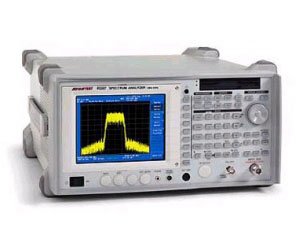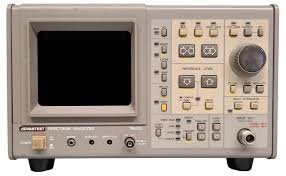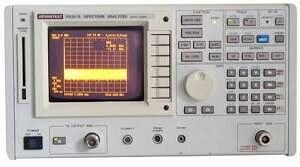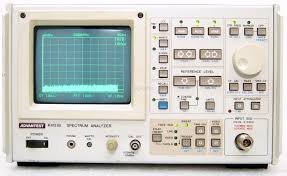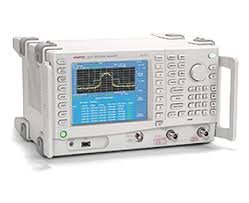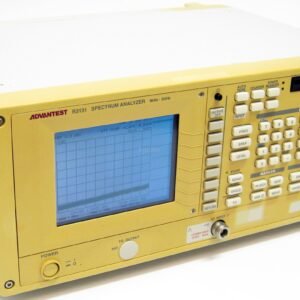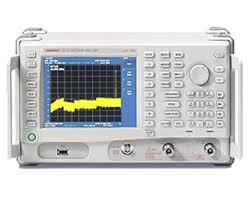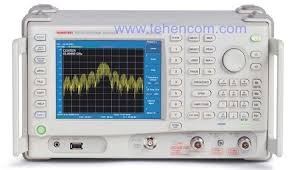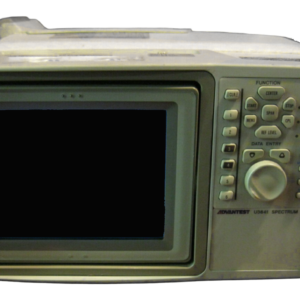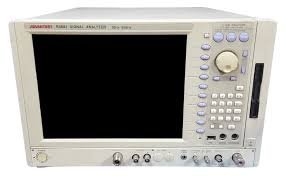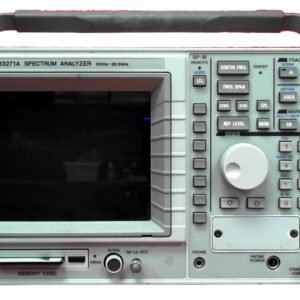
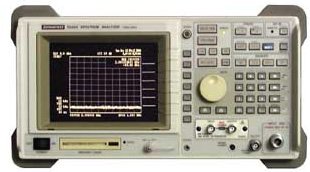

The Advantest R3265A is a portable spectrum analyzer engineered for precise signal analysis across 100 Hz to 8 GHz. This instrument delivers high sensitivity, wide dynamic range, and excellent frequency accuracy for signal analysis, component testing, and EMC measurements. The CRT display and single-sweep capability enable rapid characterization of RF and microwave signals in field and laboratory environments.
Technical Specifications
Frequency Performance
• Frequency range: 100 Hz to 8 GHz
• Linear frequency span: 200 Hz to 8 GHz, including zero span
• Linear span accuracy: ±3% (spans > 2 MHz); ±5% (spans ≤ 2 MHz)
• Logarithmic span: 1 kHz to 1 GHz, selectable in 1, 2, or 3 decades
• Logarithmic span accuracy: ±(10% + stop frequency × 0.1%)
Sensitivity and Dynamic Range
• Input sensitivity (low-noise mode): –145 dBm (1 MHz to 3.6 GHz)
• Dynamic range: 100 dB and higher for carriers at 250 MHz and above with low-frequency preselector
• Maximum dynamic range: 132 dB − 1.55 × f (GHz) from 200 MHz to 3.6 GHz
• Amplitude range: +30 dBm to average display noise level
• Display range: 10 × 10 division graticule with selectable log scales (10, 5, 2, 1, 0.5, 0.2, 0.1 dB/div) and linear scales
Spectral Purity
• Spectral purity: –110 dBc/Hz at 2.6 GHz (10 kHz offset); –108 dBc/Hz for offset frequencies > 2.6 GHz
Resolution Bandwidth
• RBW (3 dB): 10 Hz to 3 MHz, selectable in 1, 3, 10 sequence
• RBW accuracy: ±15% (100 Hz to 1 MHz); ±25% (30 Hz); ±50% (10 Hz to 100 Hz)
• Fixed bandwidth options: 200 Hz, 9 kHz, 120 kHz, 1 MHz (±10% accuracy)
• Video bandwidth: 1 Hz to 3 MHz, selectable in 1, 3, 10 sequence
– Key Features
• High-speed sweep: 5 µs/div during zero span
• Burst signal analysis for TDMA and video signals
• Gated sweep function for pulsed RF carrier monitoring
• Occupied bandwidth measurement with carrier frequency display
• Adjacent-channel leakage power measurement (70 dB dynamic range)
• EMC measurement functions
• AM and FM demodulation
• BASIC controller function for data storage and automatic measurement systems
• GPIB interface
– Typical Applications
• Signal analysis and characterization
• Component and subsystem testing
• EMC compliance verification
• Pulsed signal analysis
• Spectral purity assessment