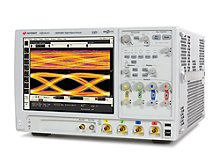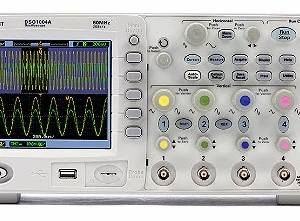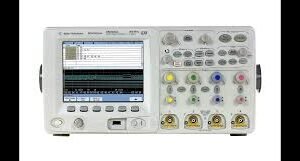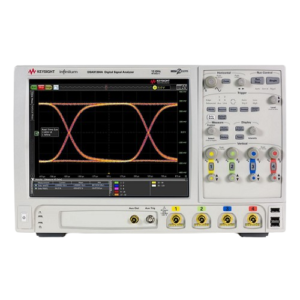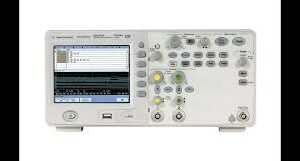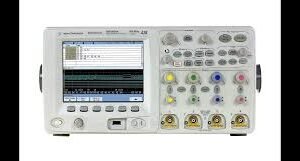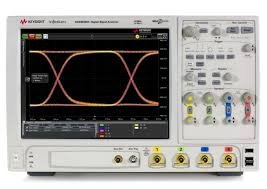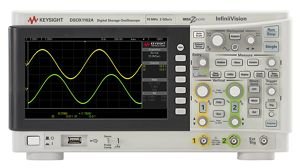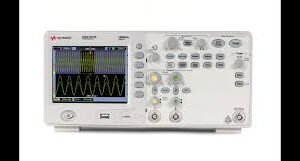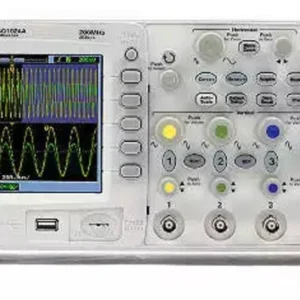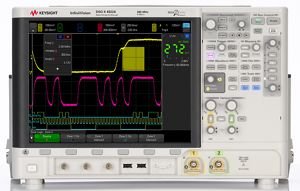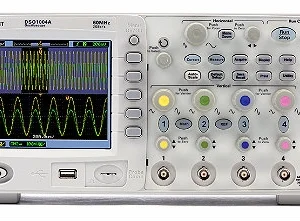
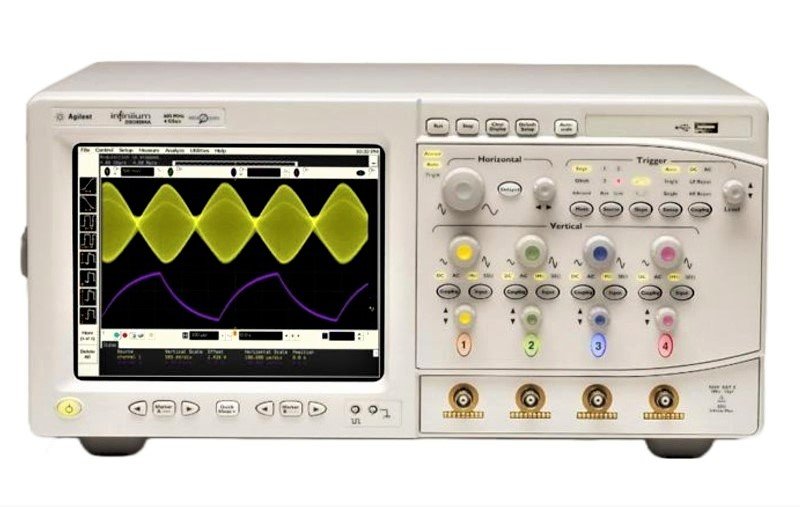

The Agilent DSO81004A is a 10 GHz real-time digital signal oscilloscope engineered for high-speed serial data analysis, signal integrity characterization, and compliance verification. With 4 simultaneous channels, configurable sample rates up to 40 GSa/s, and acquisition memory expandable to 256 Mpts per channel, it delivers the capture depth and speed required for complex digital signal examination. Real-time eye diagram generation, comprehensive jitter decomposition, and over 50 automatic measurements enable rapid identification of timing errors and signal quality issues across multiple domains.
Technical Specifications
• Real-time Bandwidth: 10 GHz
• Channels: 4 (simultaneous)
• Sample Rate: 40 GSa/s (2-channel mode), 20 GSa/s (4-channel mode)
• Acquisition Memory: 128 Mpts per channel (standard), expandable to 256 Mpts per channel
• ADC Resolution: 8 bits
• Vertical Sensitivity: 1 mV/div to 1 V/div
• Vertical Accuracy: ±1.0% of full scale
• Input Impedance: 50 Ω ± 1%
• Noise Floor: Typically less than 1.5 mVrms at 10 GHz bandwidth
• Bandwidth Limiters: Selectable at 200 MHz, 1 GHz, 3 GHz, 5 GHz, 10 GHz
• Power Requirements: 100-240 VAC, 50/60 Hz
• Operating Temperature: 0°C to 40°C
– Key Features
• Real-time eye diagram visualization for immediate signal quality assessment
• Jitter analysis with decomposition to isolate timing error sources
• Advanced trigger modes: edge, runt, glitched, window, logic, pattern, and protocol-specific
• Spectral and multi-domain analysis linking time and frequency domain correlations
• Search and mark capability for event-specific waveform interrogation
– Interfaces and Connectivity
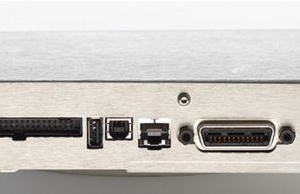
• Agilent High-Speed Interconnect (HSI) for waveform data transfer
• USB 2.0 for peripheral devices
• LAN (Ethernet) for remote control and network operation
• GPIB (IEEE 488.2) for instrument command and control
• External trigger and clock input/output (BNC connectors)
– Typical Applications
Serial data validation, eye diagram analysis, jitter characterization, multi-channel signal correlation, and protocol compliance testing on high-speed digital systems.