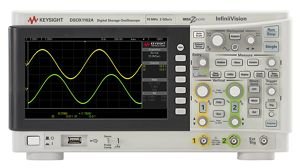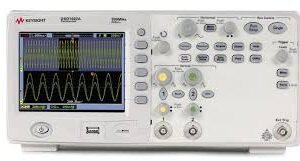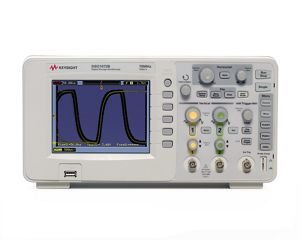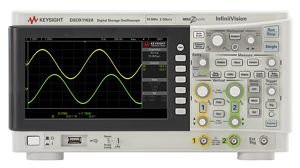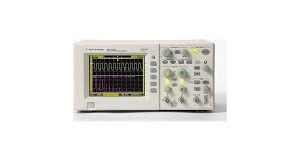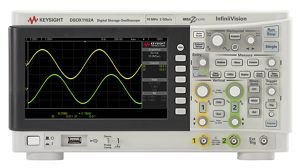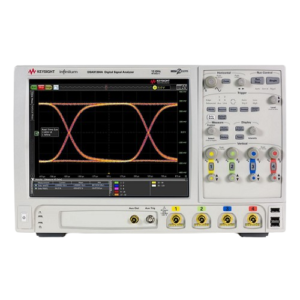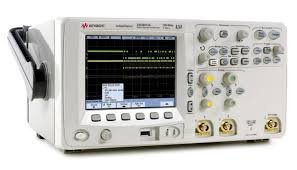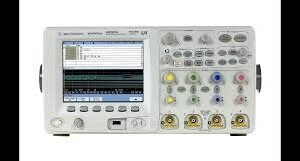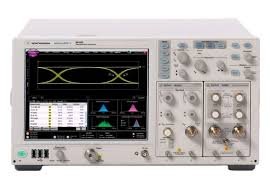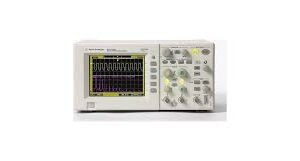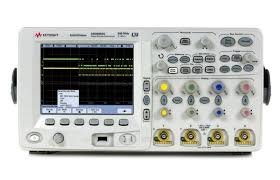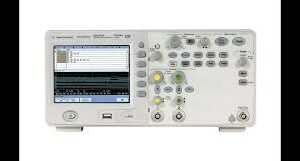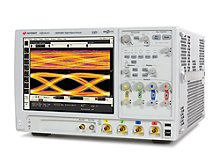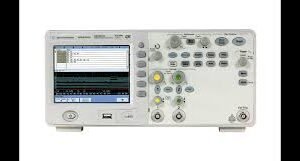
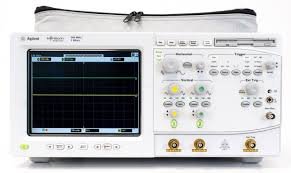

The Agilent Infiniium Oscilloscope 54810A is a 2-channel digital oscilloscope engineered for design verification and signal troubleshooting. Operating at 500 MHz bandwidth with simultaneous 1 GSa/s sampling across both channels, it delivers the real-time acquisition speed and memory depth (32K points per channel) required for complex waveform capture. The instrument combines an analog-style front panel with dedicated controls and a color LCD display alongside a Windows-based GUI, enabling rapid navigation between intuitive hardware operation and advanced measurement functions.
Technical Specifications
• Bandwidth: 500 MHz
• Channels: 2
• Real-Time Sample Rate: 1 GSa/s per channel, simultaneous
• Memory Depth: 32K points per channel
• Input Impedance: 1 MΩ or 50 Ω selectable
• Vertical Sensitivity: 1 mV/div to 5 V/div
• Display: Color LCD
• Front Panel: Dedicated knobs with trigger LEDs for status indication
– Key Features
• Triggering: Powerful trigger architecture with optional runt pulse triggering (opt. 015)
• Waveform Analysis: FFT and histogram functions for frequency-domain insight and signal characterization
• Eye Diagram Measurements: Direct support for communications system validation
• Persistence Display: Color-graded waveform persistence for temporal behavior visualization
• QuickMeas+ Key: Single-button access to four user-selectable measurements or functions
• Data Storage: 5 GByte internal hard drive; 120 MByte LS-120 SuperDisk drive with 3.5″ floppy compatibility
• File Export: ASCII, Microsoft Excel, BMP, PCX, TIF, GIF, EPS, and PS formats
• Remote Control: Web-enabled operation via Java-enabled browser; GPIB over LAN support
• E-mail on Trigger: Automated screen bitmap delivery upon trigger events
• Printer Support: HP DeskJet and LaserJet compatible
– Typical Applications
General-purpose circuit design troubleshooting, digital signal verification, and communications system testing.
– Compatibility & Integration
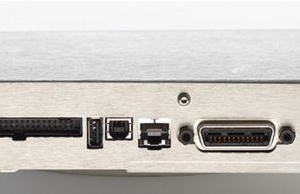
LAN (10/100 Mbps), RS-232, Centronics, GPIB over LAN, and AutoProbe interface for automatic probe configuration.