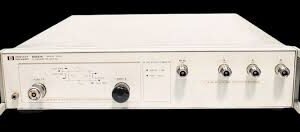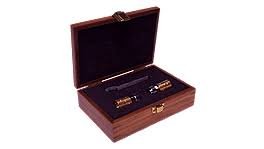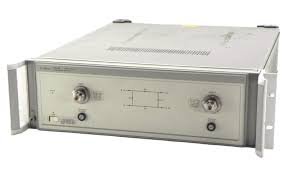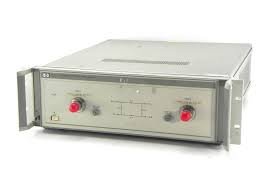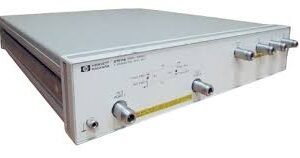
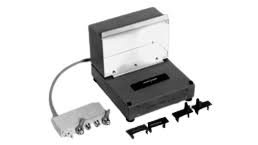

The Agilent/Keysight 16065A is a four-terminal-pair test fixture that enables external DC bias application to devices under test when an impedance analyzer or LCR meter lacks internal bias capability or cannot supply the required voltage. This fixture expands measurement versatility by decoupling bias application from the primary measurement instrument, allowing characterization of components across specified operating conditions without instrument bias limitations.
Technical Specifications
• Frequency Range: 5 Hz to 15 MHz
• Terminal Configuration: 4-Terminal Pair, BNC connectors
• DUT Connection: 2-Terminal
• Maximum DC Bias Voltage: ±200 V
• Maximum AC+DC Voltage: ±42 V peak
• Internal Series Capacitor: 5.6 µF
• Physical Dimensions: 180 mm L × 120 mm W × 200 mm H; 3.30 lbs
– Key Features
• DC isolation via internal 5.6 µF series capacitor prevents backflow of DC current into the measuring instrument, ensuring accurate AC impedance measurement during external bias application.
• Dedicated BNC connectors for DC bias input and DC bias voltage monitoring.
• Accommodates axial-lead, radial-lead, and short radial-lead component geometries.
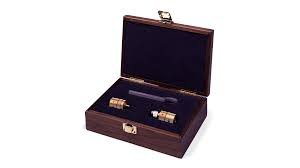
• Includes matched electrode sets and shorting bar for measurement standardization.
• Four-terminal-pair architecture maintains measurement accuracy independent of connection lead impedance.
– Typical Applications
• Impedance characterization of capacitors, inductors, and resistive networks under specified DC bias conditions.
• Component testing where bias voltage exceeds instrument internal source capability.
• Measurements on systems requiring external bias decoupling from AC measurement circuits.
– Compatibility & Integration
The 16065A connects to 4-terminal-pair LCR meters and impedance analyzers via standard BNC connections. An external DC voltage source must be supplied to the DC BIAS INPUT connector. The fixture cannot operate with an instrument’s internal bias source due to its integrated series capacitor; external bias application is mandatory. OPEN and SHORT compensation must be performed according to the connected instrument’s operating procedures.