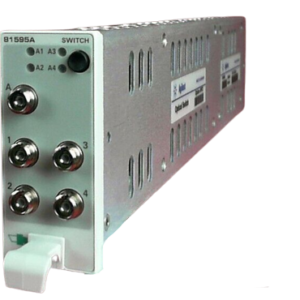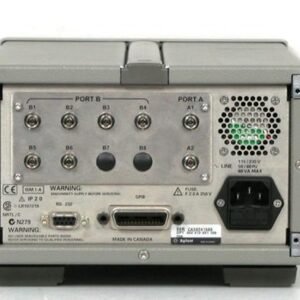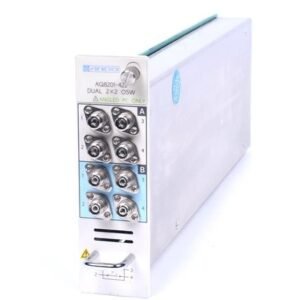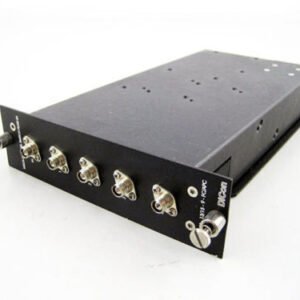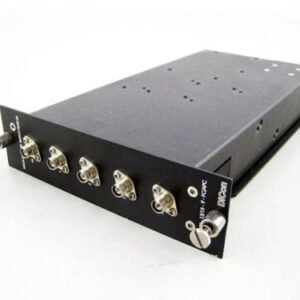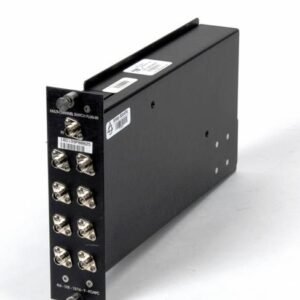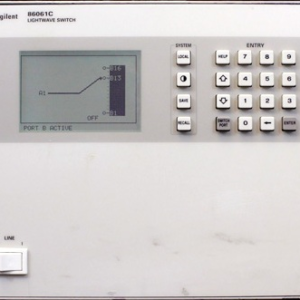
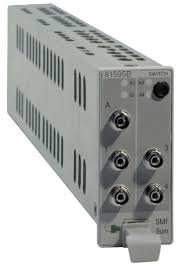

The Keysight 81595B is a 1×4 optical switch module that routes signals across four output ports with minimal loss and high repeatability. Designed for integration with Keysight 816x Lightwave mainframes, this module eliminates repeated fiber reconnections in optical communication testing and development, reducing measurement uncertainty and improving test consistency. Two options address distinct fiber types: Option 009 for single-mode fiber (9/125 µm) across 1270–1670 nm, and Option 062 for multimode fiber (62.5/125 µm) across 700–1400 nm. The multimode option maintains excellent modal fidelity, preserving signal mode distribution for reliable multimode transceiver testing.
Technical Specifications
• Switch Configuration: 1×4 optical switch
• Fiber Types: Single-mode (9/125 µm SMF) or multimode (62.5/125 µm MMF)
• Connectors: FC/APC-R angled or FC/PC straight
• Wavelength Range: 1270–1670 nm (SMF); 700–1400 nm (MMF)
• Insertion Loss: Typical <1.25 dB (SMF), <1.0 dB (MMF); maximum 2.0 dB
• Polarization Dependent Loss: 0.07 dBpp (SMF), <0.05 dB (MMF)
• Return Loss: 55 dB (SMF), 20 dB (MMF)
• Crosstalk: −70 dB typical
• Switching Time: 10 million switching cycles
• Operating Temperature: 10–45 °C
• Storage Temperature: −40–70 °C
• Humidity: Non-condensing
• Warm-up Time: 30 minutes
• Dimensions: 75 × 32 × 335 mm
• Weight: 0.5 kg
– Key Features
• Modal fidelity preservation in multimode applications
• Three control methods: front panel button, mainframe interface, or GPIB
• Low insertion loss reduces signal attenuation
• High return loss and crosstalk isolation ensure signal integrity
• Repeatable switching performance for automated test sequences
– Typical Applications
• Multimode and single-mode transceiver characterization
• Optical signal routing in automated test environments
• Modal distribution analysis in multimode systems
• High-repeatability measurement protocols
– Compatibility & Integration
The 81595B integrates directly with Keysight 8163A/B, 8164A/B, and 8166A/B Lightwave mainframes, supporting both manual and automated control via GPIB for seamless integration into test systems.