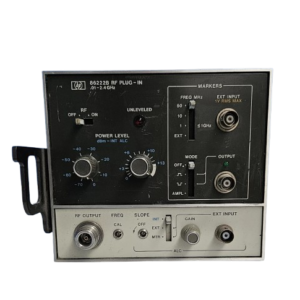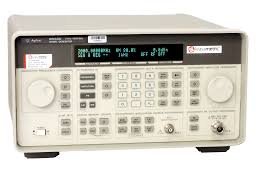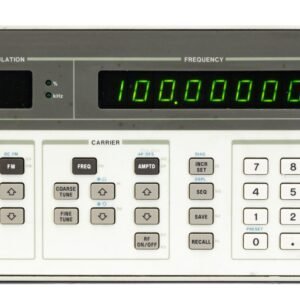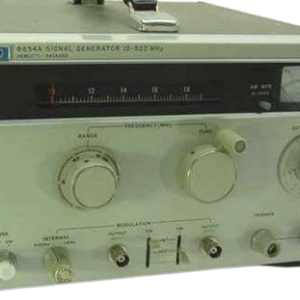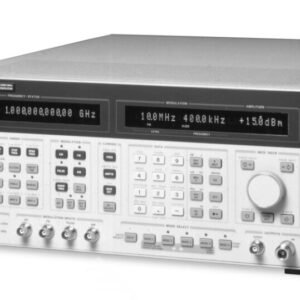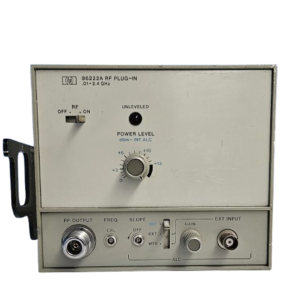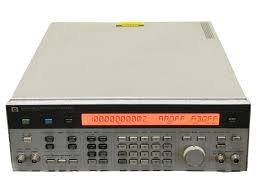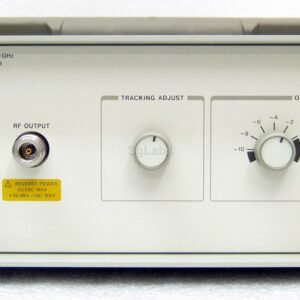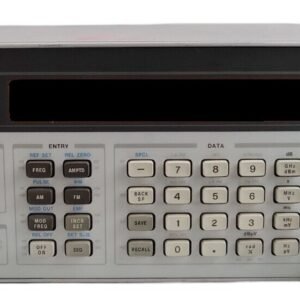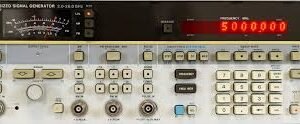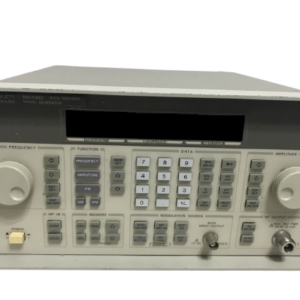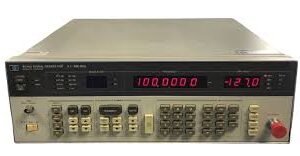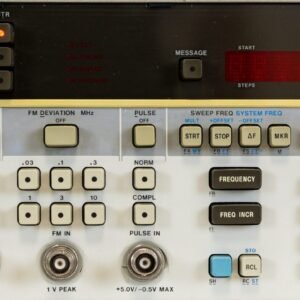
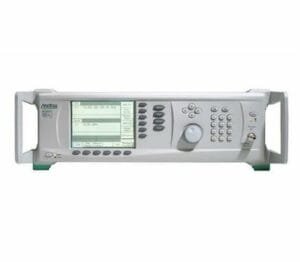

The Anritsu 68097C is a synthesized CW generator delivering precise RF and microwave signals from 10 MHz to 65 GHz. Built for defense, telecommunications, and high-performance test environments, it combines broad frequency coverage with ultra-low phase noise, rapid frequency switching, and flexible modulation capabilities. Engineers rely on it for complex signal generation, receiver characterization, and system validation where output purity and frequency accuracy are critical.
Technical Specifications
• Frequency Range: 10 MHz to 65 GHz
• Output Power: +17 dBm maximum; −125 dBm minimum; −15 dBm typical without attenuator; −120 dBm with attenuator; −140 dBm with electronic attenuator
• Output Level Accuracy: ±0.5 dB typical
• Phase Noise: Ultra-low SSB (typical −100 dBc at 10 kHz offset from 10 GHz on similar models)
• Frequency Stability: <2 × 10⁻⁸/day internal time base aging; <5 × 10⁻¹⁰/day with Option 16
• Frequency Resolution: 1 kHz minimum step; 0.1 Hz with Option 11
• Switching Time: <5 ms for sweep steps <100 MHz; typical <15 ms + 1 ms/GHz or <40 ms, whichever is less
• Spurious Signals: Low spurious levels
– Key Features
• Seven internal modulation waveforms plus user-defined modulation
• Simultaneous synchronized modulations for complex signal scenarios
• User-downloadable complex modulation capability
• Internal pulse generator for doublet, triplet, or quadruplet pulses
• Swept Delay feature for moving target simulation
• Multiple sweep modes: CW, step, digital frequency/power, alternate, manual, and list sweep
• List sweep with four tables of up to 2000 non-sequential frequency/power sets via GPIB control
• One table of 2000 points stored in non-volatile memory
• Internal high-stability time-base option available
– Interfaces & Integration
• GPIB (IEEE-488) remote control interface
• BNC connector, 50 Ω impedance for time base signal
• Rackmount form factor, 13.3 cm height
• Three-wire power cable connection required
– Typical Applications
Complex RF/microwave testing, receiver development, radar signal simulation, component characterization, and system validation in defense and telecommunications sectors.