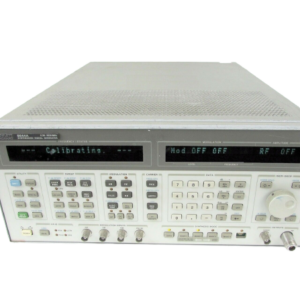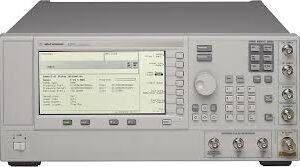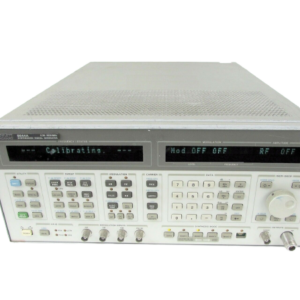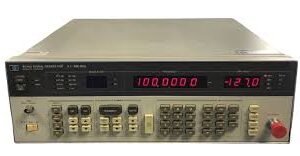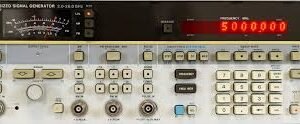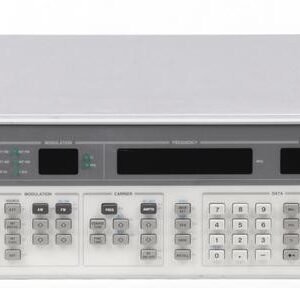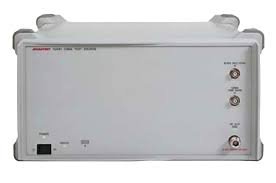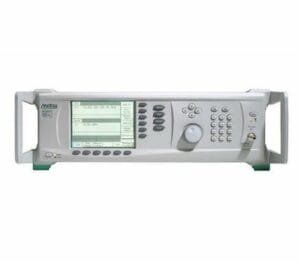

The Anritsu 68247B is a synthesized signal generator delivering phase-locked RF sources from 10 MHz to 20 GHz for RF device testing, subsystem characterization, and ATE applications. Built for commercial telecom, aerospace, and defense environments, this instrument combines ultra-low phase noise with high spectral purity across its full band. It supports discrete CW generation, broadband and narrowband sweeps, and complex modulation scenarios—making it ideal for local oscillator replacement, component analysis, and signal simulation.
Technical Specifications
Frequency Performance
• Frequency range: 10 MHz to 20 GHz
• Frequency resolution: 100.0 mHz (Option 11 provides 0.1 Hz resolution)
• SSB phase noise: –100 dBc at 10 kHz offset from 10 GHz
Output Power
• Power range: –125 dBm to +17 dBm
• Low spurious signal output
Sweep & Frequency Control
• Step sweep with variable steps (1 to 10,000) and programmable step size
• Manual stepped, phase-locked frequency adjustment
• Analog sweep capability
• Alternate sweep between two ranges with independent power levels per range
• Programmable frequency agility: up to 1,000 non-sequential frequencies stored and addressed via GPIB control
• 20 independent, pre-settable markers (F0–F9, M0–M9) for analog and step sweep identification
Modulation Capabilities
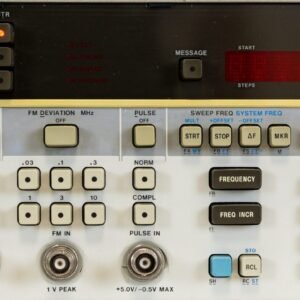
• Internal modulation: AM, FM, phase modulation, and pulse modulation
• 7 internal modulating waveforms including Gaussian noise
• User-defined arbitrary waveforms supported
• Pulse modulation via internal or external parameter setting
• Doublet, triplet, and quadruplet pulse modes for RADAR blind spot testing
• Simultaneous synchronized modulation for complex signal generation
• Option 10: Complex modulation capability
• External AM and FM modulation inputs
– Key Features
Phase-locked synthesis ensures frequency accuracy and stability across applications. Flexible sweep modes accommodate both automated test sequences and manual tuning workflows. Marker functionality enables rapid frequency identification without external measurement tools. Multiple modulation formats support radar, communication, and sensor testing scenarios.
– Typical Applications
RF component characterization, local oscillator replacement, signal simulation for receiver testing, automated production test environments, and radar/aerospace subsystem validation.
– Compatibility & Integration
GPIB control interface for remote frequency and modulation programming. Option 15 provides high-power output from 2 to 26.5 GHz for extended power applications.