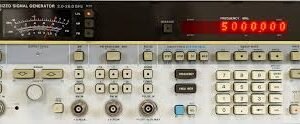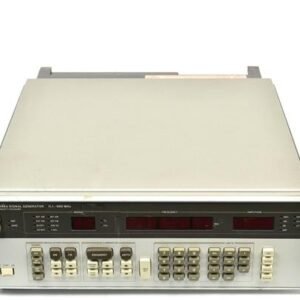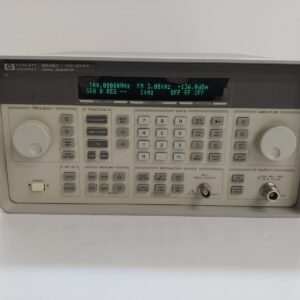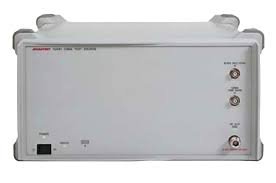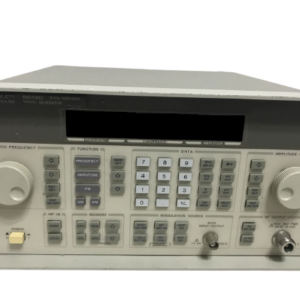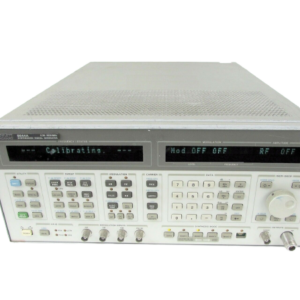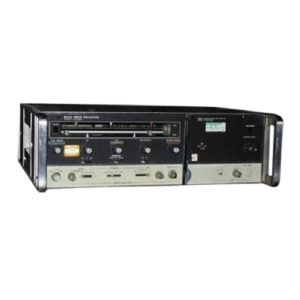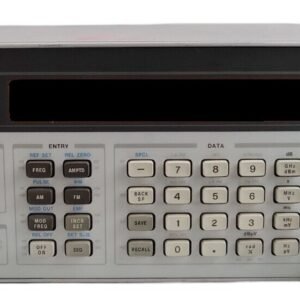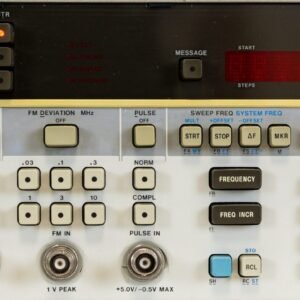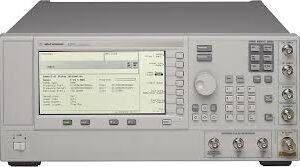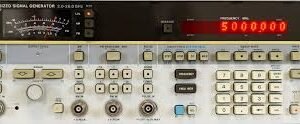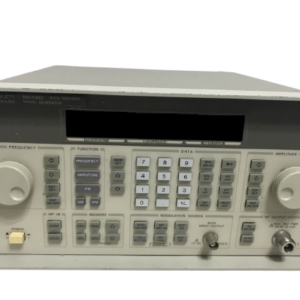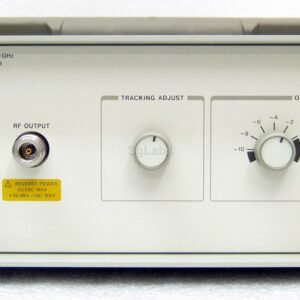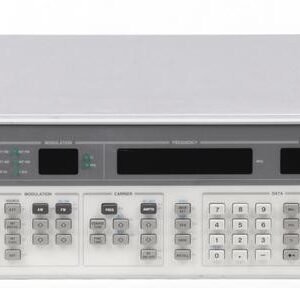
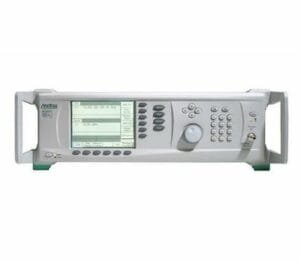

The Anritsu 68337C is a synthesized signal generator delivering precision microwave outputs across 2 to 20 GHz. It combines ultra-low phase noise, fast switching, and flexible modulation to support local oscillator duty, network analysis, ATE systems, and advanced radar/satellite applications. Phase-locked step sweeps, list mode programming, and simultaneous modulation modes enable rapid test sequences with minimal settling time.
Technical Specifications
Frequency Range: 2 to 20 GHz with 1 kHz standard resolution (0.1 Hz optional via Option 11).
Output Power: +17 dBm maximum leveled to 20 GHz; minimum –125 dBm. Option 15B (High Power) maintains +17 dBm across frequency sub-ranges. Option 22 reduces rated output by 1 dB for models with upper frequency ≤20 GHz.
Phase Noise: –107 dBc SSB at 10 kHz offset from 10 GHz.
Switching Time: Less than 5 ms for sweep steps below 100 MHz.
– Key Features
• Modulation: Internal AM (0–90% depth, DC to 100 kHz rates), FM (four modes, 10 MHz to 100 MHz deviation), and pulse generation with swept delay for moving target simulation. Doublet, triplet, and quadruplet pulses for radar blind-spot testing. Pulse on/off ratio exceeds 80 dB; rise/fall time under 10 ns.
• Waveform Support: Seven internal modulating waveforms including Gaussian noise and user-defined arbitrary waveforms. Simultaneous synchronized modulations supported.
• Sweep Modes: Digital frequency and power sweep, fast analog sweep, step sweep (1 ms to 99 seconds/step), fixed-rate step sweep (20 ms to 99 seconds/step), alternate sweep between two ranges, manual stepped adjustment, logarithmic step sweep, and list mode with up to 4 tables of 2000 non-sequential frequency/power sets.
• Low Spurious Output: Ultra-low spurious signals ensure clean spectral performance.
– Typical Applications
Satellite communications, radar systems development, wireless production testing, component characterization, and ATE integration requiring stable local oscillator sources or modulated stimulus signals.